


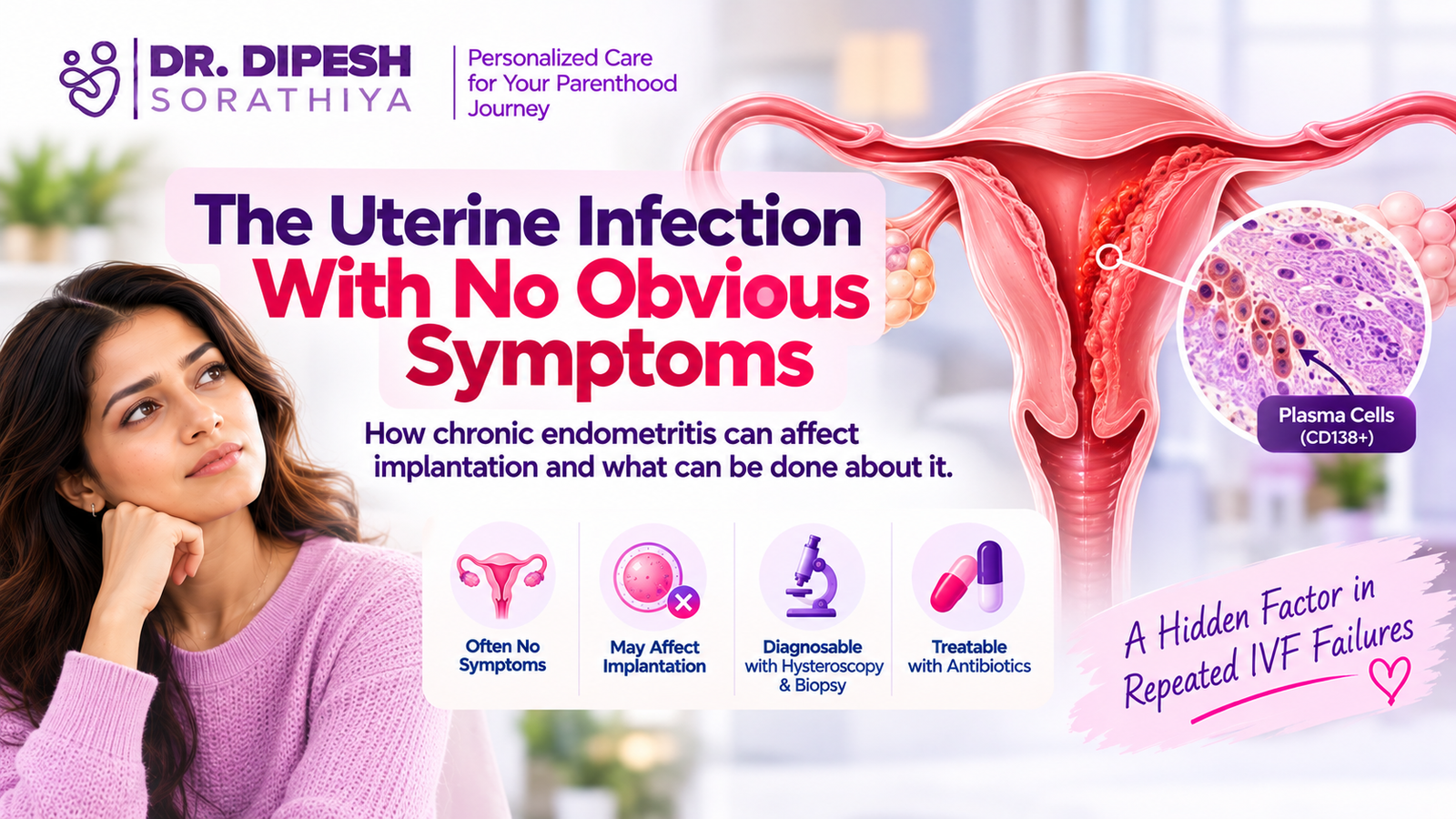
The Uterine Infection With No Obvious Symptoms
Most people associate endometritis with a painful, obvious infection — fever, discharge, pelvic pain. Acute endometritis is indeed symptomatic and usually easy to diagnose.
Chronic endometritis is entirely different. It is specifically an abnormal infiltration of plasma cells into the endometrial stroma — and clinically, the important part is that it is silent.
The prevalence range of 14–67.5% in recurrent implantation failure (RIF) is one of the broadest and most striking in reproductive medicine, reflecting how often this diagnosis has been overlooked for years.
Studies have consistently shown that when chronic endometritis is successfully treated, pregnancy and live birth rates in subsequent IVF cycles improve significantly.
Why Does Chronic Endometritis Affect Implantation?
The endometrium — the inner lining of the uterus — is where embryo implantation occurs. It needs to be in precisely the right state: receptive, immunologically welcoming, and free of abnormal inflammation.
Chronic endometritis disrupts this in several ways:
- The plasma cell infiltration alters the local immune environment, making it hostile to the implanting embryo
- Inflammatory cytokines and mediators impair the molecular "dialogue" between embryo and endometrium that is essential for successful implantation
- The condition alters expression of implantation-related proteins in the endometrium
- It may shift or distort the "window of implantation" — the narrow period when the endometrium is receptive
Who Should Be Investigated for Chronic Endometritis?
CE should be seriously considered in:
- Women with two or more failed IVF cycles with good quality embryos and no other identifiable cause
- Women with recurrent pregnancy loss (particularly early losses)
- Women with a history of uterine instrumentation (D&C procedures, hysteroscopy, multiple IUD insertions) — these can introduce or perpetuate infection
- Women with a history of pelvic inflammatory disease or STIs (particularly Chlamydia)
- Women with unexplained infertility where simpler explanations have been excluded
Diagnosis — How Chronic Endometritis Is Confirmed
Hysteroscopy
The most practical first step. Hysteroscopy allows direct visualisation of the uterine cavity. In chronic endometritis, characteristic findings include micropolyps (tiny fragile projections), stromal oedema, focal hyperaemia (redness), and a "strawberry appearance" of the endometrial surface. These findings are suggestive but not definitively diagnostic on their own.
Endometrial Biopsy with CD138 Immunohistochemistry
The gold standard for diagnosis. A small biopsy of the endometrial tissue is taken (usually at hysteroscopy or as an office procedure) and sent for specialised staining — CD138 immunohistochemistry — which specifically identifies plasma cells. The threshold for diagnosis is typically 5 or more CD138-positive plasma cells per high-power field.
Standard haematoxylin and eosin (H&E) staining is less sensitive and misses many cases. CD138 staining is specifically required for reliable diagnosis.
Endometrial Microbiome Analysis
Emerging evidence suggests that dysbiosis of the endometrial microbiome — with reduced Lactobacillus species and overgrowth of pathogenic bacteria — is associated with CE and poor IVF outcomes. This is an area of active research and is available at some specialist centres.
Treatment — Antibiotics Are the Cornerstone
Once CE is confirmed, antibiotic treatment is the primary approach.
| Scenario | Approach |
|---|---|
| Standard protocol | Doxycycline 100 mg twice daily for 14–21 days (covers most CE-associated organisms including Chlamydia, Enterococcus, and Ureaplasma), in some cases combined with metronidazole to cover anaerobes |
| Resistant or persistent CE | Ciprofloxacin or other antibiotics based on culture sensitivity if organisms are identified; combined oral antibiotics plus intrauterine antibiotic perfusion has shown promising results in studies involving RIF patients |
Confirming Cure
This step is critical and often missed in clinical practice. A repeat endometrial biopsy (control biopsy) should be taken after completing antibiotics to confirm that plasma cells have cleared.
Adjunct Therapies Under Investigation
PRP (Platelet Rich Plasma) intrauterine infusion — emerging evidence suggests potential benefit in CE patients as an add-on to antibiotics.
Repeated IVF Failure With Good Embryos? Ask About CE
Chronic endometritis is silent, commonly overlooked, and highly treatable once identified. Consult Dr. Dipesh Sorathiya at Khushhi IVF, Thaltej, Ahmedabad to discuss whether investigation is appropriate in your case.
Book an Appointment Learn About the ClinicFrequently Asked Questions
My IVF clinic never mentioned chronic endometritis. Is this normal?
Unfortunately, yes — CE is still underdiagnosed in routine fertility practice. It is more likely to be investigated at specialist centres that focus on recurrent implantation failure. If you've had two or more failed IVF cycles with good embryos, CE investigation is worth requesting.
Can chronic endometritis be caused by a previous C-section or D&C?
Yes. Uterine instrumentation is a known risk factor for introducing or perpetuating CE. This includes caesarean sections, D&C procedures, multiple IUD insertions, and prior hysteroscopic surgeries.
Does CE always cause IVF failure?
No — CE is found in some women who have had successful pregnancies. But it significantly increases the risk of implantation failure and miscarriage, particularly in women with recurrent losses.
After treating CE, how soon can we do the next IVF cycle?
After confirming CE is cleared (control biopsy), a frozen embryo transfer cycle can usually be planned within 1–2 menstrual cycles. Your specialist will advise based on your specific situation.
Khushhi IVF 5th Floor, Soham Pristine, Off Sindhubhavan Road, Thaltej, Ahmedabad, Gujarat 380054, India.
