


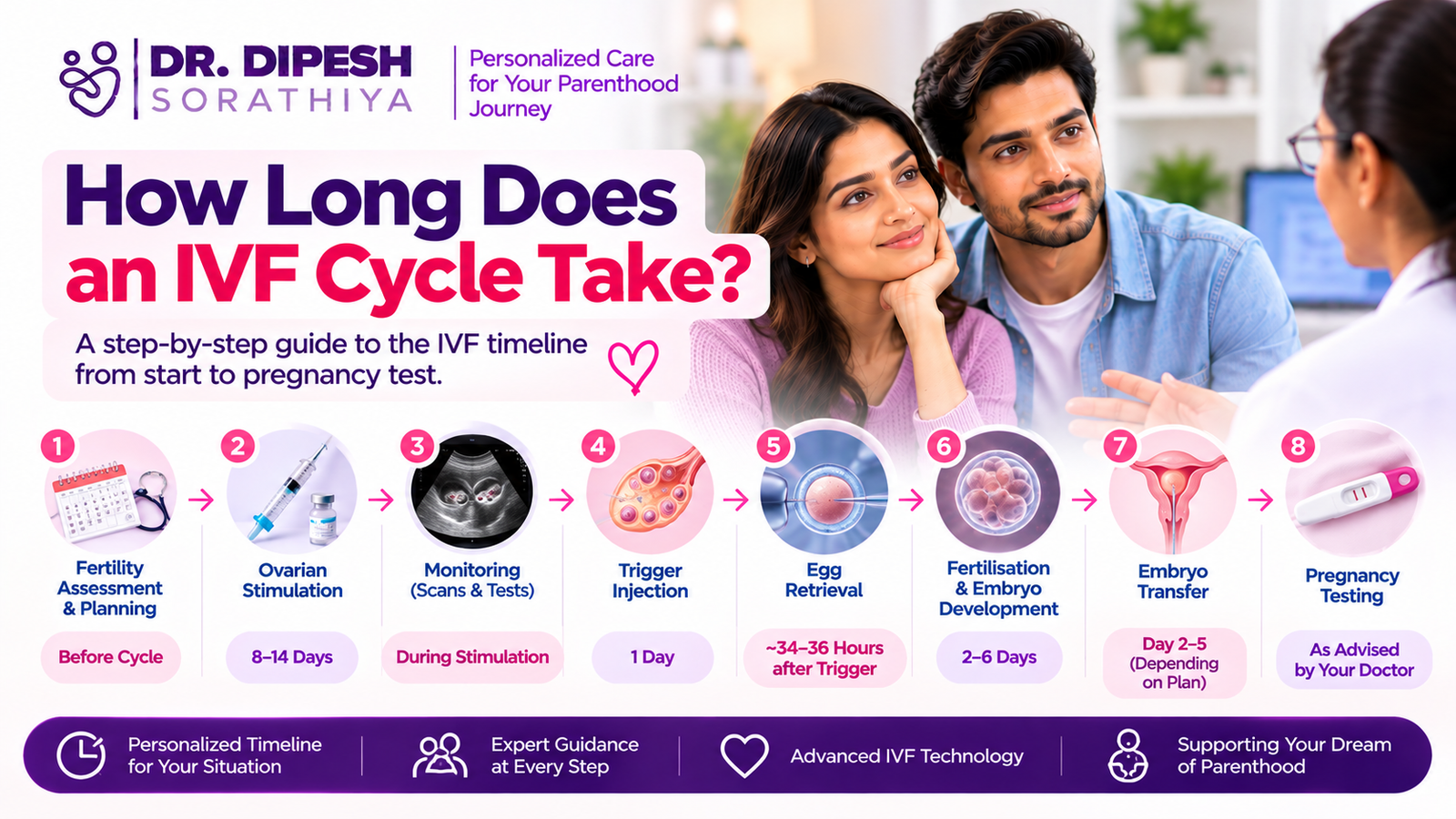
If you are planning IVF, one of the first questions is simple: how long will it take? The honest answer is that one IVF cycle usually takes about four to six weeks, counted from the start of stimulation injections to the pregnancy test. Add a few weeks before that for tests and planning. Every patient's plan is different, but the stages below are the same for most couples.
The IVF Timeline at a Glance
| Step | How Long It Takes |
|---|---|
| 1. Fertility tests and planning | 2–4 weeks |
| 2. Ovarian stimulation | About 8–14 days |
| 3. Trigger injection | About 34–36 hours before egg retrieval |
| 4. Egg retrieval | 1 day |
| 5. Fertilisation and embryo culture | 3–6 days |
| 6. Embryo transfer | 1 day |
| 7. Two-week wait and pregnancy test | About 10–14 days |
Step 1: Fertility Tests and Planning (2–4 weeks)
Before IVF starts, your doctor checks both partners. Common tests include an ovarian reserve test such as AMH, a pelvic ultrasound to count follicles, hormone blood tests, a semen analysis and routine infection screening. Based on these results, your fertility specialist chooses a stimulation plan that suits your body.
Step 2: Ovarian Stimulation (about 8–14 days)
In a natural cycle the ovaries release one egg. In IVF, daily hormone injections encourage several eggs to grow at the same time. During this phase you visit the clinic every few days for an ultrasound and sometimes a blood test, so the doctor can adjust the dose and decide the right day for egg collection.
Step 3: Trigger Injection (about 34–36 hours before egg retrieval)
When the follicles reach the right size, you receive a final "trigger" injection. It helps the eggs complete their maturation. Timing is precise, so egg retrieval is scheduled for a set hour after this injection.
Step 4: Egg Retrieval (1 day)
Egg retrieval is a short day-care procedure done under sedation, so you do not feel pain during it. A thin needle guided by ultrasound collects eggs from the follicles. Most women go home the same day and rest for the remainder of the day.
Step 5: Fertilisation and Embryo Culture (3–6 days)
In the laboratory, the eggs are fertilised with sperm, either by conventional IVF or by ICSI, where a single sperm is injected into each egg. The embryos are then grown in the lab for three to six days. Many clinics prefer to grow embryos to day 5, the blastocyst stage.
Step 6: Embryo Transfer (1 day)
A chosen embryo is placed in the uterus with a soft, thin catheter. It is usually painless and takes a few minutes. Extra good-quality embryos can be frozen for later use. In some cases the doctor advises freezing all embryos and transferring them in a later cycle.
Step 7: The Two-Week Wait and Pregnancy Test (about 10–14 days)
Around two weeks after transfer, a blood test called beta hCG shows whether pregnancy has begun. Home urine tests taken too early can give misleading results, so it is best to wait for the blood test.
What Can Make IVF Take Longer?
- A frozen embryo transfer in a later cycle instead of a fresh transfer
- Extra tests, such as genetic testing of embryos (PGT-A)
- Treating a health issue first, such as thyroid problems, fibroids or polyps
- A cycle cancelled because the response to medicines was too low or too high
Plan Your IVF Journey With Clarity
Knowing the timeline makes IVF far less stressful. If you are in Ahmedabad and considering IVF, book a consultation with Dr. Dipesh Sorathiya at Khushhi IVF, Thaltej, to understand which plan suits you and how long your treatment is likely to take.
Book an Appointment Learn About the ClinicFrequently Asked Questions
Do I need to stay in hospital during IVF?
No. Most of IVF is done on an outpatient basis. Egg retrieval is a day-care procedure, and you usually go home within a few hours.
Can I work during IVF?
Most women continue working. You may need time off for monitoring visits, the day of egg retrieval and, ideally, the day of transfer.
How many clinic visits are needed?
Typically four to six visits during stimulation, plus the retrieval and transfer days. Your doctor will give you a personal schedule.
Does IVF always take one cycle?
Not always. Some couples conceive in the first cycle; others need a frozen transfer or another cycle. Your doctor can explain what is realistic for your situation.
Khushhi IVF 5th Floor, Soham Pristine, Off Sindhubhavan Road, Thaltej, Ahmedabad, Gujarat 380054, India.
