


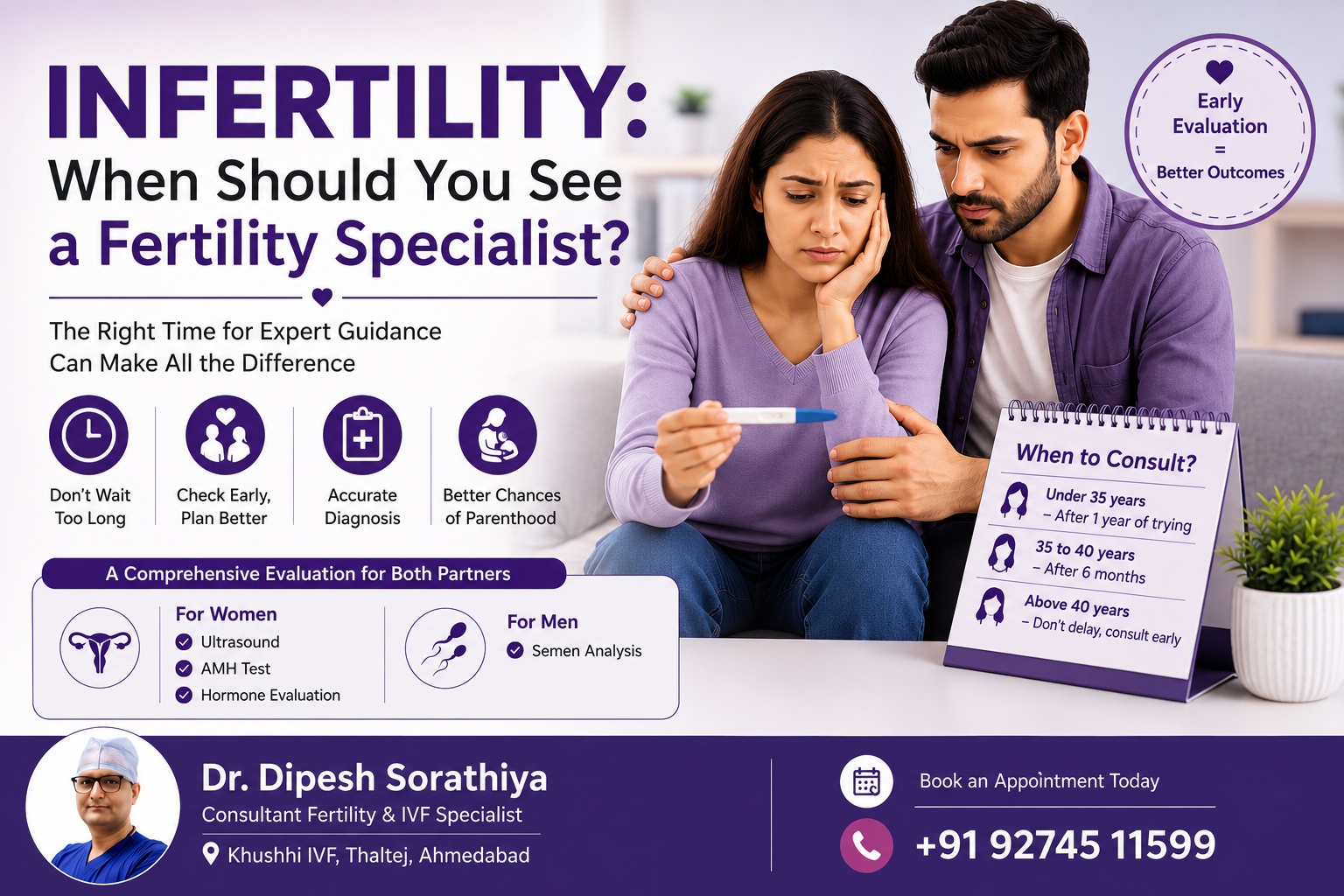
"Just wait a little longer, it'll happen naturally" — it's advice most couples hear from well-meaning family members. Sometimes it turns out to be true. But for many couples, waiting for years does more harm than good, because time is one of the biggest factors in fertility. An early diagnosis often means the solution turns out to be far simpler than expected.
The General Rule: How Long Should You Try Before Getting Checked?
| Woman's Age | When to See a Doctor |
|---|---|
| Under 35 | After 1 year of regular attempts |
| 35 to 40 | After 6 months |
| Over 40 | Right away, without delay |
When Not to Wait — See a Doctor Right From the Start
There are certain warning signs where waiting a full year simply doesn't make sense. If any of the following apply to you, get checked out immediately:
- Irregular periods — coming too early, too late, or skipping months altogether (often linked to PCOS or thyroid issues)
- A history of pelvic infection (PID) or abdominal surgery
- A diagnosis of endometriosis or fibroids
- Two or more miscarriages
- A known sperm-related issue in the male partner
Is It Only the Woman Who Gets Tested?
No — and this is one of the biggest misconceptions out there. Roughly a third of infertility cases trace back to the male partner, a third to the female partner, and the rest are either a combination of both or remain unexplained. That's why both partners should be evaluated right from the first visit. Testing for the male partner is simple — it starts with a basic semen analysis.
What Happens at the First Visit?
There's nothing to be nervous about. The first appointment is mostly a conversation, along with some baseline testing:
- Understanding your history and your partner's history
- For the woman: sonography, AMH, and hormone tests
- For the man: semen analysis
- A clear next-step plan based on the results
Many couples assume that seeing a fertility doctor automatically means jumping straight to IVF. That's simply not true. Plenty of cases are resolved with basic medication, lifestyle changes, or IUI alone.
Not Sure When to Get Started?
One initial consultation can give you the clarity you need. Schedule a joint appointment for you and your partner with Dr. Dipesh Sorathiya at Khushhi IVF, Thaltej.
Book an Appointment Learn About the ClinicFrequently Asked Questions
What counts as "a year of trying"?
Regular, unprotected intercourse — typically 2 to 3 times a week — over the course of a full year.
Can stress cause infertility?
Stress certainly doesn't help, but on its own, it's rarely the main cause of infertility. Don't let "just relax" advice mask an underlying issue that actually needs attention.
Does the husband need to come to the first visit?
Yes. When both partners are evaluated together, it saves time and leads to a faster diagnosis.
Does seeing a doctor automatically mean IVF?
No. Depending on the diagnosis, many cases are resolved with simpler treatments. IVF is just one option among several.
