


With that baseline established, let's look at the causes.
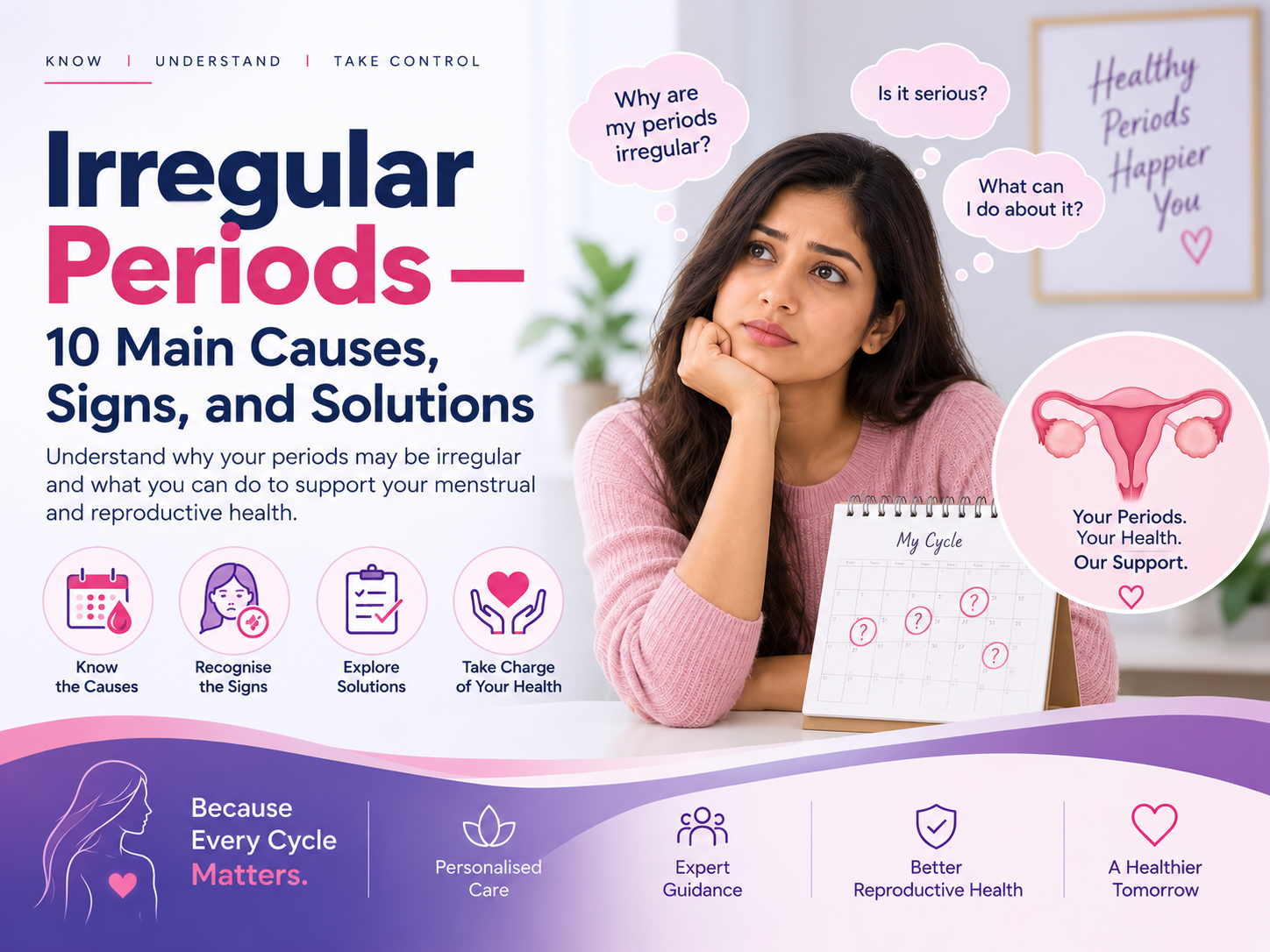
10 Main Causes of Irregular Periods
1. PCOS (Polycystic Ovary Syndrome)
The single most common cause of irregular periods in Gujarat and across India. Elevated androgens and insulin resistance disrupt ovulation — no ovulation means no regular period. PCOS deserves its own full blog (and we've written one), but it's impossible to discuss irregular periods without naming it first.
2. Thyroid Disorders
Hypothyroidism causes heavy, painful, irregular periods. Hyperthyroidism causes light, infrequent, or absent periods. A simple TSH blood test can rule this in or out within 24 hours.
3. Stress
Acute or chronic psychological stress — exams, work pressure, family problems, grief — elevates cortisol levels, which suppress the hormonal signalling pathway that drives ovulation. "My period was late because of stress" is not a myth. It is a physiological reality.
4. Significant Weight Change
Rapid weight loss (crash dieting, eating disorders) or rapid weight gain both disrupt oestrogen levels, which drives period irregularity. Women with very low body fat — gymnasts, marathon runners — often stop having periods entirely (athletic amenorrhoea).
5. Pregnancy and Breastfeeding
A missed period with possible pregnancy exposure warrants a pregnancy test before any other investigation. During breastfeeding, the hormone prolactin suppresses ovulation — period delay is expected and normal.
6. Perimenopause
Women in their 40s approaching menopause naturally experience increasingly irregular cycles — variable flow, skipped months, unpredictable timing. This is the normal hormonal transition, not a pathological process.
7. Uterine Problems — Fibroids and Polyps
Growths inside or on the uterus — fibroids (muscle growths) or polyps (glandular growths) — can cause heavy, prolonged, or irregular bleeding. An ultrasound (sonography) usually identifies these.
8. Medications
Antipsychotics, antidepressants, blood pressure medications, corticosteroids, and chemotherapy drugs can all affect the menstrual cycle. If you've recently started a new medication and your periods changed, mention it to your doctor.
9. Premature Ovarian Insufficiency (POI)
When the ovaries lose normal function before the age of 40, periods become irregular and eventually stop — an early form of menopause. Rare but important to diagnose.
10. Hyperprolactinaemia
Elevated prolactin levels (from a benign pituitary tumour called a prolactinoma, or from medications) block ovulation and cause irregular or absent periods. Easily identified on a blood test and generally very treatable.
When Should You See a Doctor?
Don't wait if:
- Your period hasn't come in 3 or more months
- Your period is so painful that it prevents normal activity
- Your bleeding is very heavy (soaking through a pad or tampon every hour for two or more consecutive hours)
- You have any bleeding after menopause (12 months without a period)
- You've been trying to conceive and periods are consistently irregular
- Irregular periods are accompanied by hair loss, weight changes, or acne — these together suggest PCOS
What Investigations Might Be Done?
- Blood tests: TSH, prolactin, FSH, LH, AMH, testosterone, fasting glucose and insulin
- Pregnancy test: To rule out as a first step
- Ultrasound (sonography): Uterus, ovaries, follicle count — PCOS, fibroids, polyps
- Hysteroscopy: A camera inside the uterine cavity — to confirm and treat polyps or fibroids
Don't Wait to Have Your Cycle Investigated
Irregular periods usually have an identifiable cause — and most are very treatable once diagnosed. Consult Dr. Dipesh Sorathiya at Khushhi IVF, Thaltej, Ahmedabad for the right tests and a treatment plan suited to your cause.
Book an Appointment Learn About the ClinicTreatment — Depends on the Cause
Every treatment should address the underlying reason, not just mask the symptom:
| Cause | Treatment Approach |
|---|---|
| PCOS | Lifestyle changes, metformin, OCP, or ovulation induction |
| Thyroid | Appropriate thyroid medication |
| Stress | Counselling, stress management, lifestyle correction |
| Weight extremes | Healthy weight restoration |
| Fibroids or polyps | Hysteroscopic removal |
| POI | Hormone replacement therapy plus specialist consultation |
| High prolactin | Cabergoline medication — very effective |
Frequently Asked Questions
Is a period 1–2 days late something to worry about?
No. Variation of 1–2 days is completely normal. Consistently coming after day 35, or missing entirely, warrants investigation.
When should I do a pregnancy test?
If your period is a week late and pregnancy is possible, do a home urine test. A blood HCG test is more sensitive and accurate.
Are there home remedies to regulate periods?
Yoga, stress reduction, a healthy diet, and maintaining a healthy weight all genuinely support cycle regularity. However, underlying causes like PCOS and thyroid cannot be self-treated — see a doctor.
Do birth control pills regulate periods long-term?
Pills regulate periods while you take them, but the underlying issue returns when you stop. They are a management tool, not a cure for the root cause.
Khushhi IVF 5th Floor, Soham Pristine, Off Sindhubhavan Road, Thaltej, Ahmedabad, Gujarat 380054, India.
