


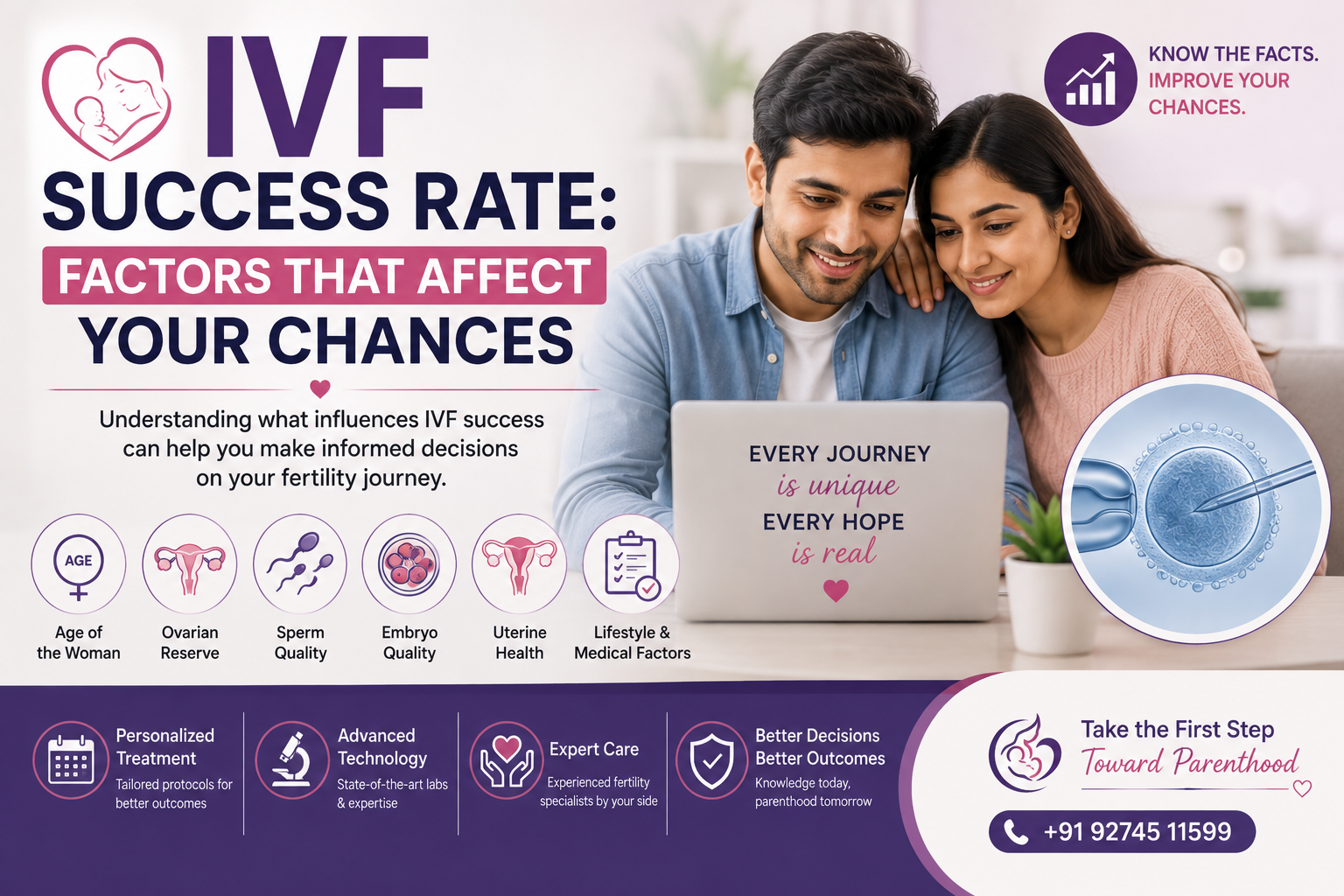
Starting IVF is a major decision, and one of the first questions many couples ask is, "What are my chances of success?" It is natural to want a clear percentage. However, IVF success is not the same for everyone. Your chances depend on several personal and treatment-related factors that go far beyond simple clinic statistics.
The challenge is that even published IVF success rates should be interpreted carefully, because they represent groups of patients, not an individual's guaranteed outcome. The CDC notes that factors such as age, diagnosis, and ovarian reserve can affect ART success, and comparisons between clinics may not always be meaningful because patient populations and treatment methods differ.
10 Key Factors That Affect IVF Success
1. Age Is One of the Most Important Factors
Female age is one of the strongest predictors of fertility and IVF outcomes. As women get older, both the number and quality of eggs generally decline. The chances of chromosomal abnormalities in embryos also increase with age, which can affect implantation, pregnancy, and live birth outcomes.
This is why IVF success rates are often reported according to age groups. However, age does not mean that IVF cannot work at an older age—it simply means that the expected chances and treatment approach may be different. Younger patients typically have higher success rates per cycle.
2. Egg Quality Matters
Having a good number of eggs does not necessarily mean that all of them will have good reproductive potential. Egg quality is closely associated with age. During IVF, several eggs may be retrieved, but not every egg will fertilize, develop into an embryo, or result in a healthy pregnancy.
This is one reason why ovarian reserve and egg quality should not be considered the same thing. A higher egg count does not guarantee better outcomes if the eggs themselves are compromised.
3. Ovarian Reserve Can Affect Treatment Planning
Ovarian reserve refers to the approximate number of eggs remaining in the ovaries. Tests such as AMH and antral follicle count (AFC) can help fertility specialists estimate ovarian reserve and anticipate how the ovaries may respond to stimulation during IVF.
However, a low AMH level does not automatically mean that IVF cannot work. ASRM notes that ovarian reserve tests are useful for predicting ovarian response and egg yield, but they are not strong independent predictors of reproductive potential or live birth. Age and the overall clinical picture remain important.
4. Sperm Quality Also Matters
IVF is not only about the woman's fertility. Sperm quality can influence fertilization and embryo development. A semen analysis typically evaluates factors such as:
- Sperm concentration — the total number of sperm present
- Sperm movement — how actively the sperm swim (motility)
- Sperm morphology — the size and shape of the sperm
Depending on the situation, your fertility specialist may recommend conventional IVF or ICSI (Intracytoplasmic Sperm Injection). The appropriate treatment should be based on the couple's medical evaluation rather than assuming that ICSI is automatically better for everyone.
5. Embryo Development Is an Important Step
Successful IVF involves several stages. Even after eggs are retrieved and fertilized, embryos need to continue developing in the laboratory. Not every fertilized egg develops into a transferable embryo.
Embryologists carefully monitor embryo development and assess which embryos may be appropriate for transfer or freezing based on established laboratory and clinical criteria. The number and quality of embryos available for transfer can therefore influence the chances of pregnancy.
6. The Cause of Infertility Can Influence Outcomes
The reason for infertility is another important consideration. Conditions such as endometriosis, tubal problems, PCOS, diminished ovarian reserve, male-factor infertility, uterine conditions, and unexplained infertility can affect treatment planning and outcomes in different ways.
A fertility specialist will consider the diagnosis alongside age, ovarian reserve, previous treatment history, and other factors before recommending an IVF strategy tailored to your specific situation.
7. Uterine and Endometrial Health
Even when a good-quality embryo is available, implantation also depends on the uterine environment. Your doctor may evaluate the uterus and endometrium when clinically appropriate. Conditions affecting the uterus or endometrial lining may require treatment or further evaluation before embryo transfer.
The aim is to identify and address factors that could affect implantation and pregnancy, ensuring the best possible environment for embryo development.
8. Previous IVF History Matters
Your previous response to fertility treatment can provide useful information for planning future treatment. Your doctor may consider:
- Number of eggs retrieved
- Fertilization results
- Embryo development
- Number of embryos available
- Previous implantation outcomes
- Previous pregnancy outcomes
- Response to ovarian stimulation
This information can help your fertility team personalize the next treatment cycle for improved outcomes.
9. Lifestyle and Overall Health
Lifestyle is not a guarantee of IVF success, but maintaining good general health is an important part of preparing for fertility treatment. Helpful habits include:
- Eating a balanced diet rich in nutrients
- Maintaining a healthy weight
- Staying physically active with regular exercise
- Avoiding smoking completely
- Limiting excessive alcohol consumption
- Getting adequate sleep (7-9 hours per night)
- Managing stress through relaxation techniques
- Taking medications and supplements only as recommended by your doctor
If you have diabetes, thyroid disease, hypertension, or another medical condition, appropriate management before and during fertility treatment is also important.
10. IVF Laboratory Quality Matters
IVF involves highly specialized laboratory procedures. Embryo culture, fertilization techniques, cryopreservation, laboratory quality control, and embryology expertise are all important components of an IVF program.
However, it is important not to judge a clinic only by a single advertised success-rate number. A clinic's patient population, age distribution, infertility diagnoses, treatment protocols, and reporting methods can all affect its reported results. The CDC specifically cautions that success rates from different clinics may not be directly comparable.
Does a Higher IVF Success Rate Guarantee Pregnancy?
No. A clinic's overall success rate cannot tell you exactly what your individual chances will be. For example, two patients of the same age may have very different ovarian reserves, diagnoses, sperm parameters, embryo development, and medical histories.
Instead of asking only "What is your IVF success rate?", consider asking your fertility specialist these more meaningful questions:
- What factors affect my individual chances?
- How is my ovarian reserve?
- What does my semen analysis show?
- How many eggs might we expect to retrieve?
- What treatment approach is appropriate for me?
- What are the realistic expectations for my age and diagnosis?
- What happens if the first cycle does not succeed?
These questions can provide a much more meaningful understanding of your treatment plan and individualized chances of success.
Can IVF Success Be Improved?
There is no guaranteed method to make IVF successful. However, appropriate patient evaluation and individualized treatment planning can help doctors address relevant fertility factors effectively.
The goal should not simply be to maximize the number of eggs retrieved. Instead, the focus should be on developing an appropriate treatment strategy based on:
- Your age and reproductive health status
- Your diagnosis and medical history
- Your ovarian response to stimulation
- Sperm factors (if applicable)
- Embryo development patterns
- Your previous treatment response
ASRM emphasizes that ovarian reserve testing should be interpreted alongside age, diagnosis, risk factors, and previous treatment response rather than being used in isolation.
Every IVF Journey Is Different
It is easy to compare your IVF journey with someone else's experience, especially when you hear stories of couples becoming pregnant after one cycle. However, fertility treatment is highly individual.
Some couples may achieve pregnancy during their first IVF cycle, while others may need more than one attempt or a change in treatment strategy. A failed cycle does not necessarily mean that future treatment will not work.
The most useful approach is to understand your own fertility factors rather than comparing your situation with someone else's. Your journey is unique, and your success depends on factors specific to you and your partner.
Want to Understand Your Individual IVF Success Rate?
Every couple's fertility profile is different. A detailed consultation with a fertility specialist can help you understand your personal chances, treatment options, and realistic expectations. Dr. Dipesh J. Sorathiya provides comprehensive fertility assessment and personalized IVF planning.
Book a Consultation Learn About Khushhi IVFFrequently Asked Questions
What is the average IVF success rate?
IVF success rates vary significantly based on age, clinic, patient population, and other factors. For women under 35, success rates per cycle typically range from 40-50%. For women 35-37, rates are around 30-40%. For women 38-40, rates drop to 20-30%. For women over 40, success rates are generally under 10% per cycle. These are national averages and individual results may vary.
How much does age affect IVF success?
Age is the single most important factor affecting IVF success. Female age determines both egg quantity and quality. Women in their late 20s and early 30s have the highest success rates. After age 35, success rates decline gradually, and the decline accelerates after age 40. Male age also matters but typically has less impact than female age.
Can low ovarian reserve still result in IVF pregnancy?
Yes. While low ovarian reserve (indicated by low AMH levels) predicts fewer eggs retrieved, it does not guarantee IVF failure. Quality matters more than quantity. Some women with low ovarian reserve achieve pregnancy with IVF, while others with high reserves may not. Individual response to treatment varies significantly.
Does male-factor infertility reduce IVF success rates?
Male-factor infertility can be effectively addressed through IVF, particularly with ICSI (Intracytoplasmic Sperm Injection). Success rates for male-factor cases depend on the specific sperm parameters and whether ICSI is indicated. Many couples with male-factor infertility achieve successful pregnancies with appropriate IVF treatment.
What happens if my first IVF cycle fails?
A failed cycle does not mean future cycles will fail. Many couples need multiple attempts. Important data from the first cycle—such as egg yield, fertilization rates, and embryo development—helps your doctor adjust the protocol for subsequent cycles. Frozen embryos from the first cycle also provide additional chances at lower cost.
How can I improve my IVF success chances?
Optimize your chances by: maintaining good overall health, managing stress, eating a balanced diet, maintaining healthy weight, avoiding smoking and excessive alcohol, exercising regularly, getting adequate sleep, addressing any underlying medical conditions, and following your doctor's recommendations precisely. Work with your fertility team to develop a personalized treatment plan.
