


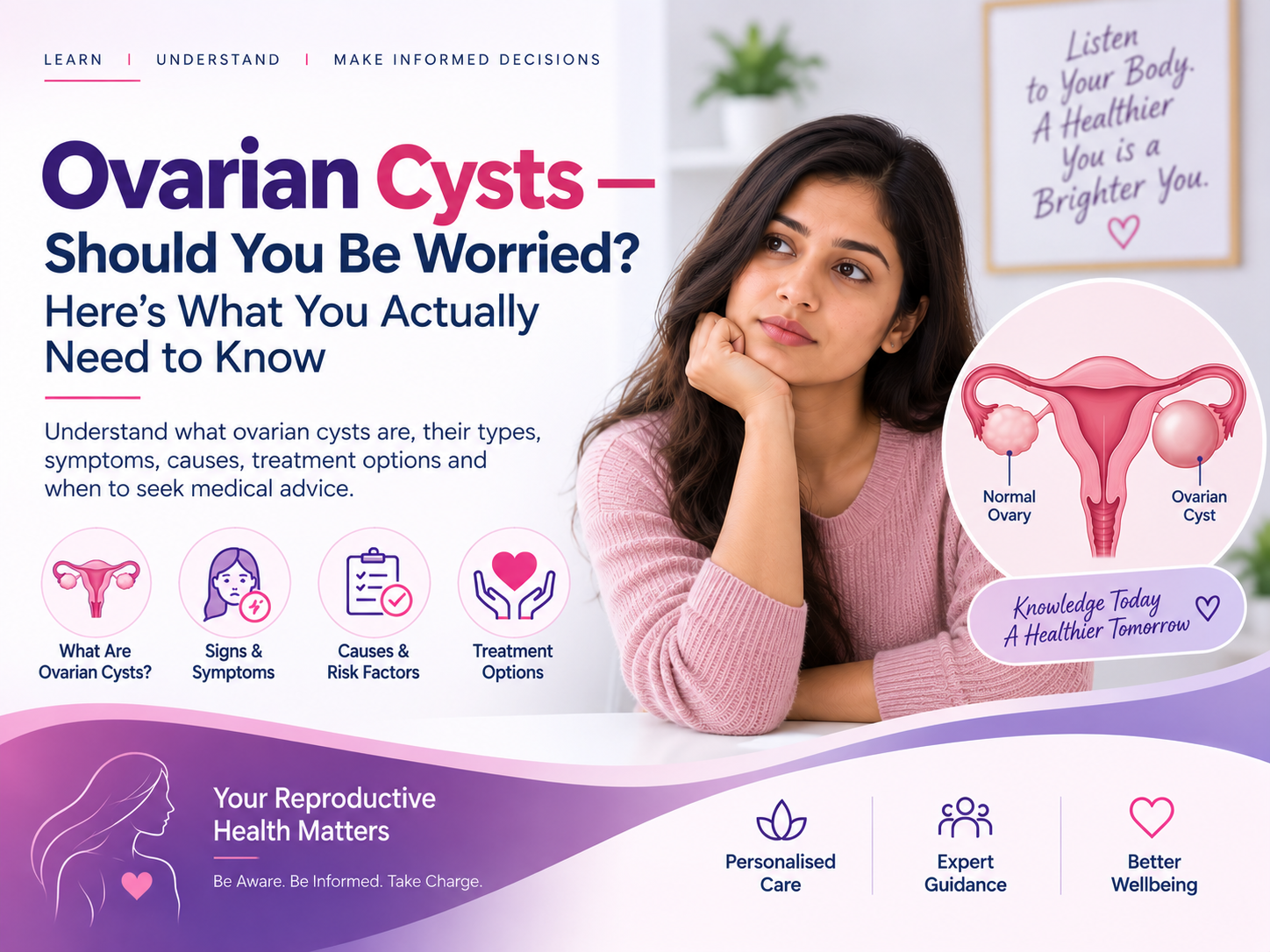
The ovary produces an egg each month through a process involving small fluid-filled sacs called follicles. Occasionally, one of these sacs doesn't behave as expected — it persists or grows larger than it should. This is a cyst.
Types of Ovarian Cysts
1. Functional Cysts — Most Common, Usually Harmless
- Follicular cyst: A follicle that didn't release its egg and kept growing. Most resolve within 6–8 weeks on their own.
- Corpus luteum cyst: After ovulation, the empty follicle sac fills with fluid and persists. Most resolve within 1–2 menstrual cycles.
2. Dermoid Cyst (Teratoma)
A cyst that can contain hair, skin, teeth, or fat — formed from egg cells. Usually benign. Generally requires surgical removal, but not urgently.
3. Endometrioma (Chocolate Cyst)
Caused by endometriosis. The cyst fills with old, dark blood — giving it a characteristic dark brown colour on surgical view. Affects fertility and should be assessed carefully.
4. Cystadenoma
Forms on the outer surface of the ovary, filled with fluid. Generally benign. If it grows very large, surgical removal is considered.
5. PCOS-Related Follicles
In PCOS, multiple small immature follicles are visible on sonography — these are often called "cysts" though they are actually immature eggs. They're part of PCOS, not independent cysts.
6. Malignant (Cancerous) Cysts
Rare. Risk factors include age over 50, strong family history, and BRCA gene mutations. Warning features include a solid component, irregular borders, rapid growth, and elevated CA-125 blood marker.
Symptoms — What Ovarian Cysts Feel Like
Most cysts produce no symptoms and are found on routine sonography. When symptoms occur:
- Dull ache or cramping in the pelvis
- Bloating or a feeling of fullness
- Pain during intercourse
- Irregular periods
- Frequent urination (with large cysts pressing on the bladder)
Sudden, severe pelvic pain · Nausea and vomiting · Fever · Shoulder pain (referred from internal bleeding)
These may indicate ovarian torsion (the ovary twisting on itself) or a ruptured cyst — both require urgent medical attention.
Diagnosis
- Transvaginal ultrasound (TVS): Assesses cyst size, location, and character — simple fluid-filled vs complex
- CA-125 blood test: Not perfectly specific, but helps assess cancer risk alongside other features
- MRI: Used in complex or indeterminate cases
- Laparoscopy: Definitive — allows direct visualisation and treatment simultaneously
Treatment Options
| Approach | What It Involves |
|---|---|
| Watch and Wait | Functional cysts in younger women — monitor over 2–3 menstrual cycles. Most resolve without any intervention. |
| Oral Contraceptive Pills | Can prevent new functional cysts from forming. Do not shrink existing ones. |
| Laparoscopic Cystectomy | Surgical removal of the cyst with the ovary preserved — the preferred approach when the ovary can be saved. Fertility is maintained. |
| Oophorectomy | Removal of the entire ovary — only in cases of suspected malignancy or when the cyst has destroyed all healthy ovarian tissue. |
Most Ovarian Cysts Don't Need Surgery — Get a Clear Diagnosis First
An ultrasound and the right follow-up can tell you exactly what kind of cyst you have and what — if anything — needs to be done. Consult Dr. Dipesh Sorathiya at Khushhi IVF, Thaltej, Ahmedabad for a clear assessment.
Book an Appointment Learn About the ClinicImpact on Fertility
- Small functional cysts: Minimal fertility impact
- Endometriomas: Can reduce ovarian reserve — careful decision-making required about surgery
- PCOS follicles: Affect ovulation but not egg supply — managed through PCOS treatment
- After surgery: Careful technique is essential to protect healthy ovarian tissue
Frequently Asked Questions
Is an ovarian cyst the same as cancer?
No. Over 95% of ovarian cysts are benign. Ovarian cancer is rare and has very different characteristics from a typical functional cyst.
Do all cysts need surgery?
No. Most functional cysts are simply monitored and resolve naturally. Surgery has specific indications — size, complexity, persistence, or cancer concern.
Can I get pregnant if I have an ovarian cyst?
In most cases, yes. Functional cysts rarely affect fertility. Endometriomas need to be assessed before treatment planning for fertility.
Will the cyst come back after surgery?
Functional cysts can recur — they're part of normal ovarian function. Endometriomas have a recurrence rate of 15–30% over 5 years. Medical management after surgery helps reduce this.
Khushhi IVF 5th Floor, Soham Pristine, Off Sindhubhavan Road, Thaltej, Ahmedabad, Gujarat 380054, India.
