


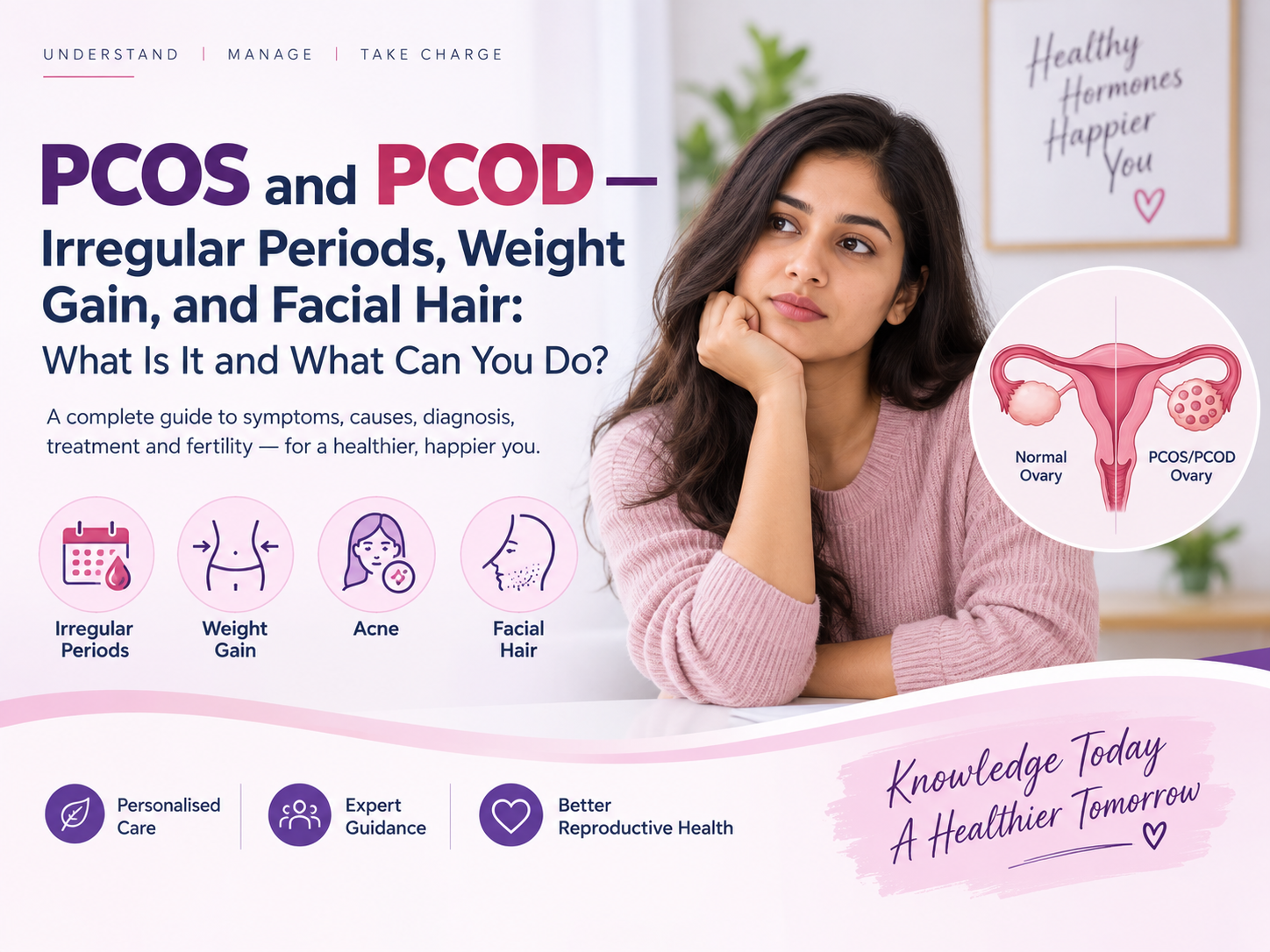
If you are experiencing irregular or missed periods, unwanted hair on the face, neck, or abdomen, worsening acne, difficulty losing weight, or trouble getting pregnant — this blog is written specifically for you.
Symptoms of PCOS — Know What to Look For
No two women with PCOS look exactly alike. The symptoms vary significantly from person to person. But the most common signs are:
1. Irregular or Absent Periods
Many women with PCOS get their period every 3–4 months, or even every 6 months. Sometimes the flow is very light; other times it's unexpectedly heavy. Irregular periods are the most recognisable hallmark of PCOS.
2. Unwanted Hair on the Face, Chin, Neck, Chest, or Abdomen (Hirsutism)
This happens because of elevated androgen (male hormone) levels. For many women, this is one of the most distressing and embarrassing aspects of PCOS.
3. Acne — Particularly on the Lower Face, Neck, and Back
Hormonal acne is a classic PCOS sign. It tends not to respond well to regular skincare products because the root cause is internal.
4. Weight Gain — Especially Around the Abdomen and Waist
Because of insulin resistance (where the body's cells don't respond properly to insulin), losing weight becomes genuinely difficult — not a matter of willpower.
5. Hair Loss / Thinning
Significant hair fall, especially from the top of the scalp, is common in PCOS.
6. Dark Patches on the Skin (Acanthosis Nigricans)
Dark, velvety patches may appear on the neck, underarms, or behind the knees. This is a direct sign of insulin resistance.
7. Mood Swings, Anxiety, Depression
Hormonal imbalance has a real and significant effect on mental health. Many women with PCOS experience emotional ups and downs that feel disproportionate or hard to control.
8. Difficulty Getting Pregnant
PCOS is the single most common cause of ovulatory infertility in India. When ovulation doesn't happen regularly, the chance of natural conception is reduced.
Why Does PCOS Happen? — The Causes
The exact cause of PCOS isn't fully understood yet, but these factors play an important role:
Insulin Resistance
In many women with PCOS, the body's cells don't respond effectively to insulin. To compensate, the pancreas produces more insulin. This excess insulin then stimulates the ovaries to produce more androgens (male hormones) — which disrupts ovulation and causes many of the symptoms.
Genetics
If your mother, grandmother, or close female relatives have PCOS, irregular periods, diabetes, or thyroid problems, your risk is higher. PCOS runs strongly in families.
Lifestyle Factors
A diet high in refined carbohydrates and sugar, a sedentary lifestyle, and chronic stress can all trigger or worsen PCOS. This doesn't mean you caused your PCOS — but it does mean lifestyle changes can make a real difference.
Androgen Sensitivity
Some women's skin and ovaries are more sensitive to normal levels of androgens, which amplifies the visible symptoms like hair growth and acne.
How Is PCOS Diagnosed?
Doctors use the Rotterdam Criteria to diagnose PCOS. At least two of the following three conditions must be present:
- Irregular or absent ovulation — shown by irregular or missed periods
- Elevated androgens — detected on blood tests (free testosterone, DHEAS) or visible as acne, hirsutism
- Polycystic ovaries — 12 or more follicles visible on ultrasound (sonography)
| Test | What It Checks |
|---|---|
| Ultrasound (Sonography) | Ovarian size and follicle count |
| Blood Tests | LH, FSH, AMH, Testosterone, DHEAS, fasting insulin, fasting blood glucose, TSH (thyroid), Prolactin |
| Lipid Profile | Cholesterol and triglycerides |
Important myth to clear: Seeing cysts on a sonography does NOT automatically mean PCOS. Many normal women have follicles visible on ultrasound. A proper PCOS diagnosis requires all three criteria assessed together — clinical signs, blood tests, and ultrasound.
Treatment — Step by Step
PCOS has no permanent cure, but up to 90% of its symptoms can be effectively controlled. Treatment depends on your specific goal — managing symptoms, regulating periods, or achieving pregnancy.
Step 1: Lifestyle Changes — The Most Powerful Tool
Lose even 5% of your body weight — and periods can start becoming regular again. For overweight women with PCOS, sustained weight loss is more effective than any injection, pill, or medication. When body weight drops by just 5%, hormones begin to rebalance.
What to eat:
- Whole grains: brown rice, jowar, bajra, oats, multigrain roti
- Vegetables, legumes, leafy greens (spinach, fenugreek)
- Protein: dal, paneer, eggs, lean chicken, fish
- Healthy fats: nuts, seeds, olive oil
- Plenty of water — 8 to 10 glasses a day
What to reduce:
- Refined flour (maida), white rice, sugar, sweets
- Packaged and processed foods, chips, biscuits
- Cold drinks and packaged juices
- Excess dairy (some women with PCOS benefit from limiting dairy)
Exercise:
- 30 minutes of walking daily — the best single exercise for PCOS
- Yoga: Suryanamskar, butterfly pose, child's pose
- Resistance training with weights or bands — directly improves insulin sensitivity
Step 2: Medications (Always Under Doctor's Guidance)
Metformin — Addresses insulin resistance directly. Helps regulate periods, makes weight loss more achievable, and reduces androgen levels.
Letrozole (Ovulation Induction) — The first-line fertility treatment for women with PCOS who want to conceive. Triggers ovulation when the body isn't doing it on its own.
Oral Contraceptive Pills (OCP) — Regulate periods, reduce acne, and manage hirsutism. Used when pregnancy is not the immediate goal.
Spironolactone — Helps manage unwanted hair growth and hormonal acne by blocking androgen effects.
Clomiphene Citrate — An alternative to letrozole for ovulation induction in some cases.
Step 3: PCOS and Getting Pregnant
The question most PCOS patients ask is: "I have PCOS — can I get pregnant?"
The answer is yes. Pregnancy is absolutely possible.
The typical fertility treatment pathway for PCOS looks like this:
- Lifestyle changes + Metformin — 3 to 6 months
- Letrozole + Timed intercourse + Follicle monitoring — 3 to 6 cycles
- IUI (Intrauterine Insemination) — 3 to 4 cycles
- IVF — when other options have not worked
Women with PCOS often produce a large number of eggs during IVF, which typically means excellent IVF outcomes. The idea that PCOS equals infertility is completely wrong.
Managing PCOS Starts With the Right Guidance
Whether your goal is regular periods, symptom control, or pregnancy, Dr. Dipesh Sorathiya can help you build a treatment plan suited to your individual situation. Consult at Khushhi IVF, Thaltej, Ahmedabad.
Book an Appointment Learn About the ClinicLong-Term Health Risks of Untreated PCOS
PCOS is not just a period and fertility problem. Left unmanaged, it increases the long-term risk of:
- Type 2 Diabetes — driven by insulin resistance
- Heart Disease — from elevated cholesterol, blood pressure, and chronic inflammation
- Endometrial Cancer (Uterine Cancer) — irregular periods mean the uterine lining doesn't shed regularly, which over years increases cancer risk
- Anxiety and Depression — both through hormonal mechanisms and the emotional burden of living with the condition
All of these risks can be meaningfully reduced through proper lifestyle management and regular medical follow-up.
Frequently Asked Questions
At what age can PCOS develop?
From the time periods begin (puberty) through to menopause. In Gujarat studies, the 18–23 age group is the most commonly affected.
When should I see a doctor?
If your period hasn't come in 3 months, if you've been trying to conceive for 6–12 months without success, or if your symptoms are significantly affecting your quality of life — see a doctor without delay.
Can PCOS be completely cured?
There is no permanent cure, but symptoms can be very well managed. Many women find that symptoms lessen naturally after menopause.
Does seeing cysts on ultrasound mean I definitely have PCOS?
No. Many perfectly healthy women have follicles visible on sonography. A diagnosis of PCOS requires at least two of the three Rotterdam criteria — sonography alone is not enough.
What's a good diet for women with PCOS in India?
Multigrain thepla, millet khichdi, methi shaak, katho, dahi — all excellent. Maida dhebra, fafda, jalebi, and cold drinks should be minimised.
Can thin women get PCOS?
Absolutely. Around 20% of women with PCOS have a normal BMI. "Lean PCOS" is a real and well-recognised phenomenon. Weight is just one factor among many.
Khushhi IVF 5th Floor, Soham Pristine, Off Sindhubhavan Road, Thaltej, Ahmedabad, Gujarat 380054, India.
