


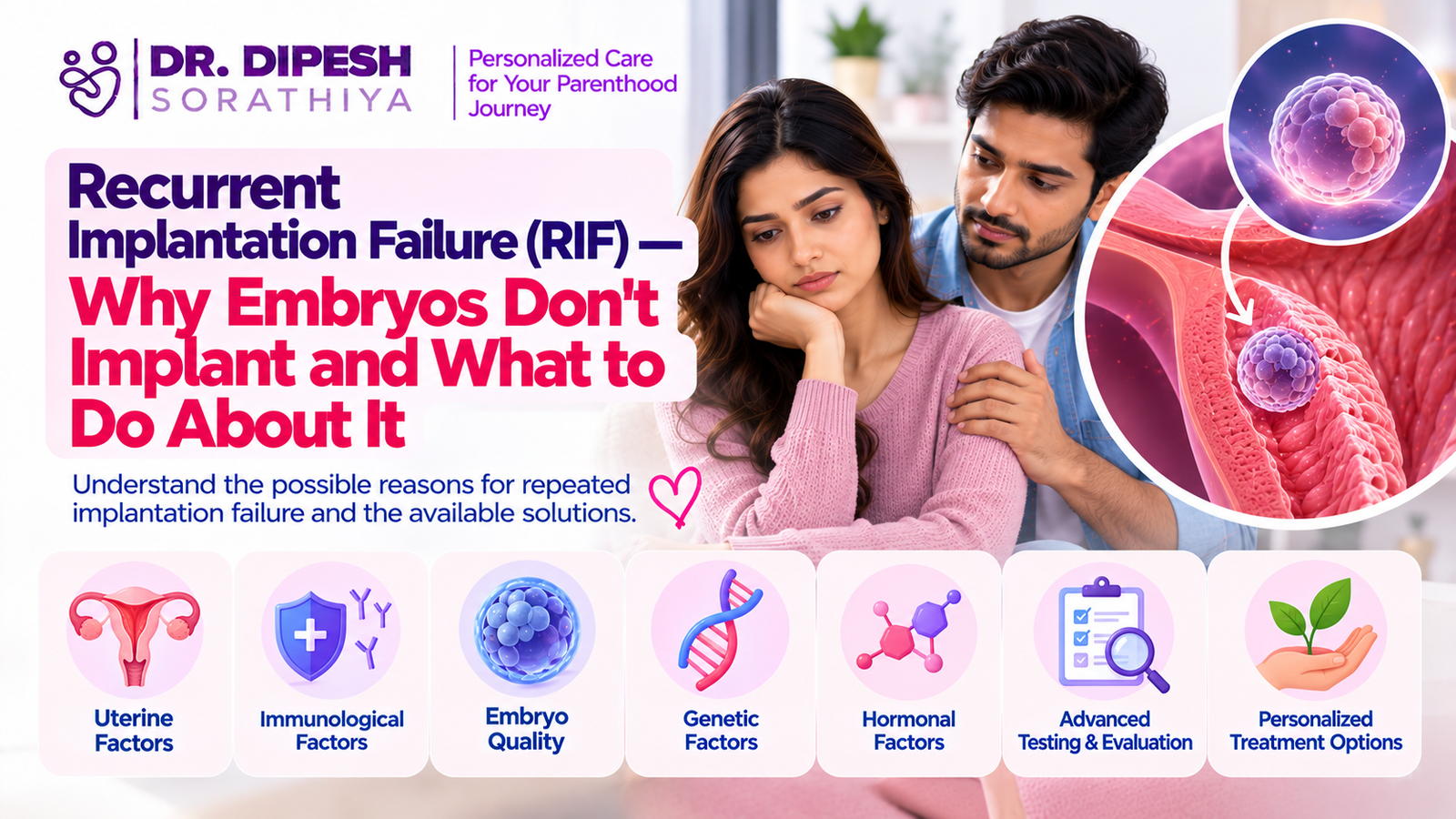
When Good Embryos Don't Implant — the Most Frustrating IVF Scenario
You've done everything right. The stimulation went well. The eggs retrieved were good. Fertilisation was successful. You had two, three, maybe four beautiful blastocysts. The transfers went smoothly.
And nothing.
Cycle after cycle — negative results, early losses, or empty pregnancy tests where there should be a heartbeat.
Defining RIF — When Does It Apply?
The definition of RIF varies between centres, but a widely accepted working definition is:
This distinguishes RIF from simple IVF failure — where one or two cycles haven't worked, which may simply reflect the inherent per-cycle success rates rather than a specific underlying problem.
Causes of Recurrent Implantation Failure
RIF can arise from factors related to the embryo, the uterus, or both — and often a combination.
Embryo-Related Causes
- Aneuploidy (chromosomal abnormality): The most common. As maternal age increases, the proportion of chromosomally abnormal embryos rises steeply. Embryos that look perfect morphologically may carry chromosomal errors invisible to the eye. PGT-A (Preimplantation Genetic Testing for Aneuploidies) identifies these.
- Sperm DNA fragmentation: Poor sperm DNA quality can produce embryos that develop to blastocyst stage but cannot implant or sustain a pregnancy.
- Poor embryo culture conditions: Laboratory factors (media, oxygen levels, temperature stability) can affect embryo quality subtly without being detectable on grading.
Uterine-Related Causes
- Chronic endometritis (CE): Found in 14–67.5% of RIF patients. A silent inflammatory condition of the endometrial lining. Treatable with antibiotics after confirmation by CD138 biopsy.
- Hydrosalpinx: Fluid in a blocked fallopian tube leaks into the uterine cavity and is embryo-toxic. Surgical treatment (salpingectomy or proximal tube ligation) before IVF dramatically improves outcomes.
- Uterine polyps or submucosal fibroids: Physically obstruct implantation. Removable by hysteroscopy.
- Uterine septum: A congenital partition dividing the cavity — surgically correctable with excellent post-operative outcomes.
- Asherman's syndrome: Intrauterine adhesions (scar tissue) from prior surgery or infection. Treated by hysteroscopic adhesiolysis.
- Shifted implantation window: The window of implantation — the narrow period when the endometrium is receptive — is at a standard time in most women (day 5 after a 5-day blastocyst). In some, it is displaced by 12, 24, or 48 hours. The ERA (Endometrial Receptivity Analysis) test identifies this shift and allows the transfer to be precisely timed to that individual's personal window.
- Thin endometrium: Lining consistently under 7mm — caused by inadequate oestrogen, poor blood flow, or Asherman's syndrome. Treatment approaches include extended oestrogen preparation, sildenafil (Viagra), low-dose aspirin, PRP intrauterine infusion, and occasionally G-CSF.
Immunological Causes
- Elevated uterine Natural Killer (NK) cells: NK cells at elevated levels may destroy the implanting embryo or early placenta. Investigated at specialist centres; treated with corticosteroids or intralipid infusions.
- Antiphospholipid syndrome: Blood clotting disorder affecting placental blood flow. Treated with aspirin and low-molecular-weight heparin.
- Thrombophilias: Inherited clotting tendencies — some are associated with implantation failure and early pregnancy loss.
Investigation — The RIF Workup
A thorough RIF workup typically includes:
| Investigation | What It Checks |
|---|---|
| PGT-A on embryos | Chromosomal normality of embryos |
| Hysteroscopy + CD138 biopsy | Chronic endometritis; uterine cavity |
| ERA test | Personalised implantation window |
| 3D ultrasound / SIS | Polyps, septum, fibroids, cavity |
| Sperm DFI | DNA fragmentation |
| Antiphospholipid antibody panel | Clotting disorder |
| Thrombophilia screen | Inherited clotting factors |
| NK cell testing | Immunological RIF |
| Uterine blood flow (Doppler) | Endometrial vascularity |
| Thyroid, Prolactin, Glucose | Hormonal factors |
Don't Keep Repeating Cycles Without Answers
After two or three failed transfers with good embryos, a targeted RIF workup is more valuable than another cycle. Consult Dr. Dipesh Sorathiya at Khushhi IVF, Thaltej, Ahmedabad to discuss which investigations fit your history.
Book an Appointment Learn About the ClinicFrequently Asked Questions
How many failed cycles before investigating for RIF?
Most specialists begin a targeted RIF workup after 2–3 good-quality embryo transfers in women under 38. Don't wait for more cycles without investigating.
Is PGT-A always the answer for RIF?
PGT-A is very useful when age or history suggests embryo chromosomal issues may be the primary problem. But it won't help if the issue is uterine (endometritis, thin lining, shifted window) — both sides must be investigated.
Can RIF ever be unexplained?
Yes — even after thorough investigation, some cases remain unexplained. In these situations, supportive treatments (progesterone, aspirin, corticosteroids, intralipid), combined with emotional support and close monitoring, are used. Many unexplained-RIF couples eventually succeed.
Khushhi IVF 5th Floor, Soham Pristine, Off Sindhubhavan Road, Thaltej, Ahmedabad, Gujarat 380054, India.
