


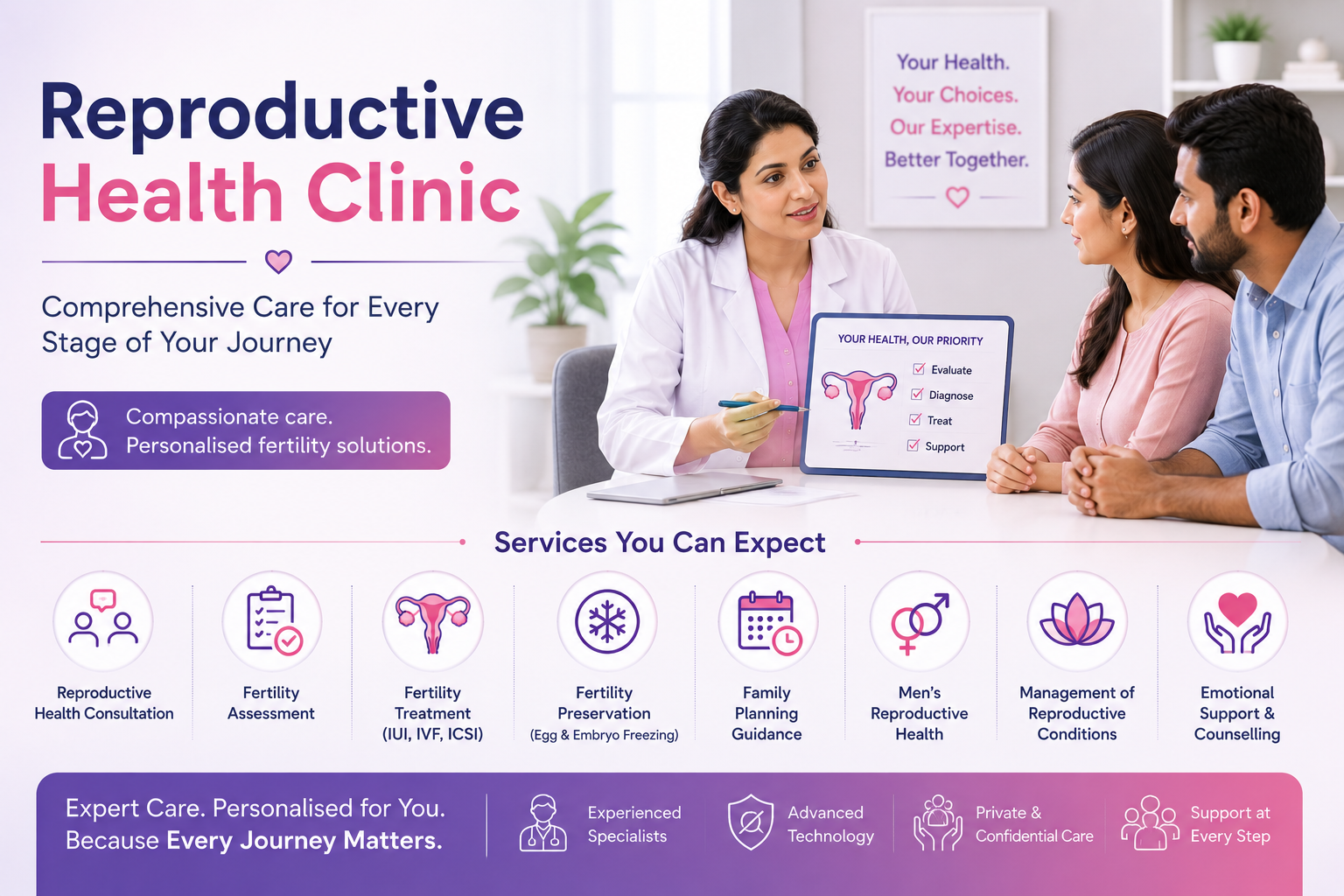
Reproductive health is an important part of overall health and can influence many stages of life, from menstrual health and contraception to fertility planning, pregnancy and family building. When you have questions or concerns about your reproductive health, a reproductive health clinic can provide medical evaluation, guidance and appropriate care based on your individual needs.
Understanding the services available can help you decide when it may be useful to seek professional advice.
What Is a Reproductive Health Clinic?
A reproductive health clinic is a healthcare setting where individuals can receive evaluation and guidance related to reproductive and sexual health. Depending on the clinic and the specialists available, services may include reproductive health consultations, fertility assessment, management of certain reproductive conditions, family planning and fertility treatment.
The exact services offered vary between clinics. A consultation can help determine which type of evaluation or care may be appropriate for your situation.
What Services Can You Expect From a Reproductive Health Clinic?
The services available depend on the clinic, medical team and your individual requirements. Common areas of reproductive healthcare may include the following.
1. Reproductive Health Consultation
A consultation provides an opportunity to discuss your concerns, medical history and reproductive goals with a healthcare professional. You may want to discuss:
- Menstrual or reproductive health concerns
- Family planning
- Difficulty conceiving
- Previous pregnancy problems
- Fertility preservation
- Known reproductive conditions
- Future pregnancy plans
The doctor can then determine whether further evaluation or specialist care may be appropriate.
2. Fertility Assessment
If you are experiencing difficulty conceiving, a reproductive health and fertility assessment may help identify factors that could be affecting fertility.
Depending on the individual situation, assessment may consider both partners. Medical history, menstrual and ovulation patterns, previous pregnancies, reproductive conditions and other relevant factors may be reviewed.
For women, investigations may sometimes include assessment of ovulation, ovarian reserve, the uterus or fallopian tubes when clinically indicated. For men, semen analysis can be an important part of fertility evaluation.
Not everyone needs the same tests. A fertility physician generally recommends investigations based on medical history and clinical findings.
3. Fertility Treatment Guidance
When a fertility concern is identified, a reproductive health clinic may provide guidance regarding appropriate treatment options.
Depending on the diagnosis and individual circumstances, options may include medical management, cycle monitoring, IUI, IVF or ICSI.
Treatment should not be selected simply because it is available. Factors such as age, reproductive history, test results, diagnosis and fertility goals can influence which approach may be appropriate.
4. Family Planning Guidance
Reproductive health also includes planning for future pregnancy. If you are not currently trying to conceive but are considering having children in the future, a reproductive health consultation can provide an opportunity to discuss your reproductive goals and relevant factors that may affect future fertility.
Early discussion may be particularly useful when there are known medical or reproductive concerns.
5. Fertility Preservation
Some people may wish to preserve their reproductive potential for future family planning. Depending on individual circumstances, fertility preservation may involve options such as egg freezing or embryo freezing.
Whether fertility preservation is appropriate depends on factors such as age, reproductive goals, medical history and the reason for considering preservation. A specialist can explain the available options and their limitations.
6. Management of Fertility-Related Conditions
Certain medical conditions can affect reproductive health and fertility. Examples may include:
- PCOS
- Endometriosis
- Low ovarian reserve
- Certain uterine conditions
- Tubal problems
- Male fertility factors
- Hormonal or ovulation-related concerns
A reproductive health clinic can assess the situation and determine whether specialist evaluation or treatment may be appropriate.
When Should You Visit a Reproductive Health Clinic?
There is no single reason for visiting a reproductive health clinic. You may consider a consultation if you have a specific concern or simply want professional guidance about your reproductive health.
A consultation may be appropriate if you:
- Have difficulty conceiving
- Have irregular or absent periods
- Have a known reproductive health condition
- Have experienced repeated pregnancy loss
- Have concerns about ovarian reserve
- Have a history of reproductive or pelvic surgery
- Have concerns about male fertility
- Are considering fertility preservation
- Are planning a pregnancy in the future
- Want to understand your fertility options
Seeking advice does not automatically mean that you will require fertility treatment. The purpose of an initial consultation is to understand your individual situation.
Reproductive Health and Fertility Assessment: Why Both Partners Matter
Fertility is a shared aspect of family planning. Difficulties conceiving can involve female factors, male factors, a combination of factors or sometimes no clearly identifiable cause.
For this reason, evaluating both partners when appropriate can provide a more complete understanding of the situation.
For women, factors involving ovulation, ovarian reserve, uterus and fallopian tubes may be considered. For men, factors involving sperm production, sperm quality and reproductive health may be assessed.
A fertility specialist can recommend appropriate investigations based on the couple's history and circumstances.
What Happens During a Reproductive Health Consultation?
Your first consultation will generally begin with a discussion of your concerns and medical history. The doctor may ask about:
- Your menstrual and reproductive history
- Previous pregnancies
- Previous fertility treatments
- Existing medical conditions
- Previous surgeries
- Medications
- Family history where relevant
- Your current reproductive goals
Based on this information, the doctor may recommend further examination or investigations. You can also use the consultation to ask questions about your fertility, treatment options and what to expect from the next stage of care.
Why Personalised Reproductive Healthcare Matters
Reproductive health is different for every individual. A treatment or investigation that is appropriate for one person may not be necessary for another.
Personalised care takes into account your medical history, age, reproductive goals, symptoms, previous investigations and other relevant factors. This approach can help avoid unnecessary testing and ensure that treatment decisions are based on your individual circumstances.
Reproductive Health Clinic and Fertility Care in Ahmedabad
Dr. Dipesh Sorathiya, Fertility & IVF Specialist, provides personalised fertility evaluation and reproductive care in Ahmedabad — helping you understand your situation and appropriate options based on your medical history and reproductive goals.
Book an Appointment Learn About the ClinicFrequently Asked Questions
Do I need any fertility tests before treatment is recommended?
Not everyone needs the same tests. A fertility physician generally recommends investigations based on your medical history and clinical findings.
Should my partner also be evaluated?
Fertility is a shared aspect of family planning, and evaluating both partners when appropriate can provide a more complete understanding of the situation.
Should I consider fertility preservation?
Whether fertility preservation is appropriate depends on factors such as age, reproductive goals, medical history and the reason for considering preservation — a specialist can explain the available options.
Do I need IUI, IVF or another treatment?
Depending on the diagnosis and individual circumstances, options may include medical management, cycle monitoring, IUI, IVF or ICSI. Treatment should be based on your individual evaluation rather than what is simply available.
Dr. Dipesh Sorathiya
Fertility & IVF Specialist | Ahmedabad
???? +91 92745 11599
???? drdipeshsorathiya.com
Khushhi IVF 5th Floor, Soham Pristine, Off Sindhubhavan Road, Thaltej, Ahmedabad, Gujarat 380054, India.
