


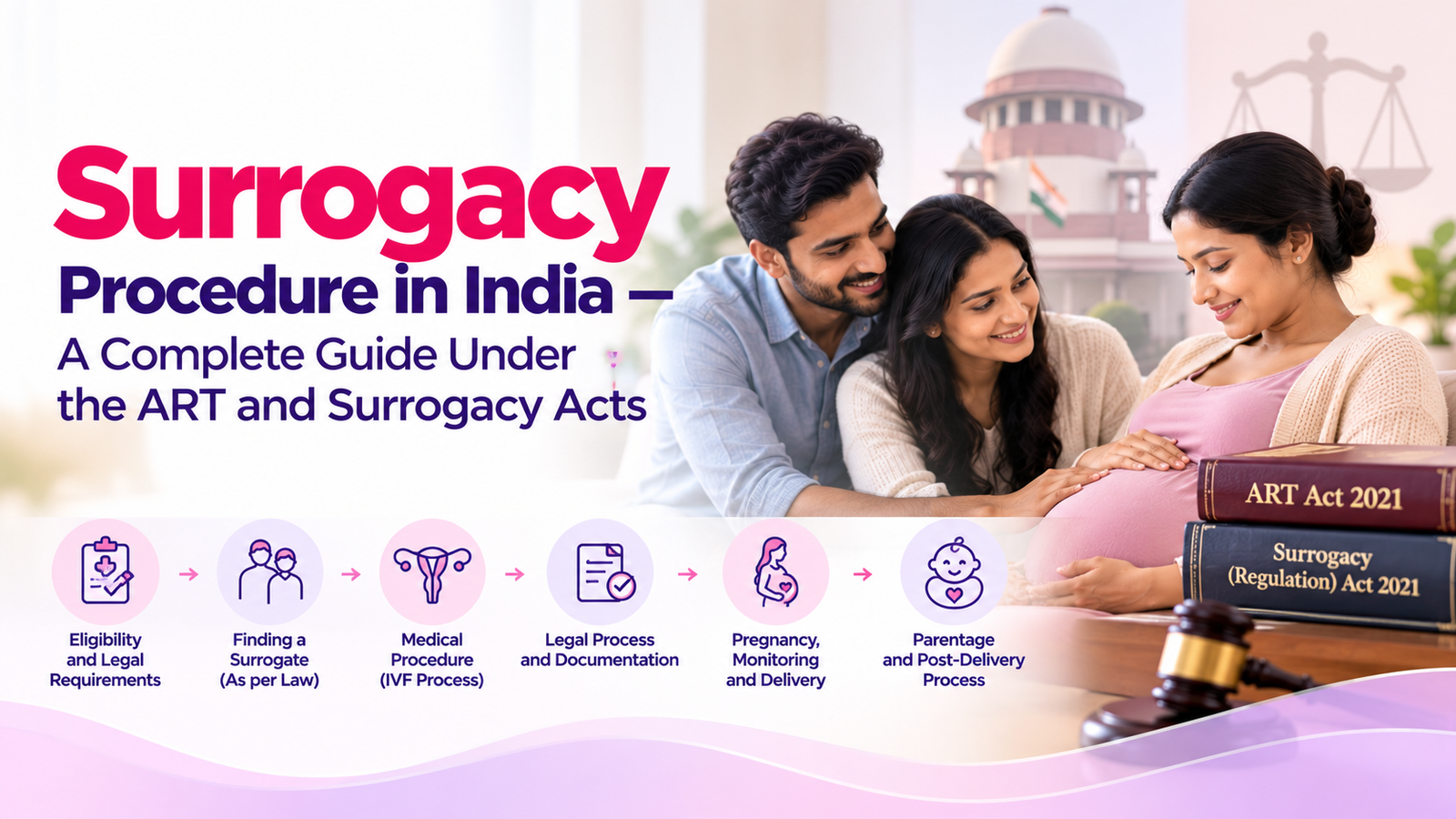
Surrogacy in India — After the Law Changed
India was once one of the most prominent destinations in the world for commercial surrogacy. Thousands of international couples came each year, drawn by relatively accessible medical care and lower costs compared to Western countries.
This guide walks through the complete procedure from start to finish.
Two Types of Surrogacy — Which Applies in India
| Type | Status in India |
|---|---|
| Gestational surrogacy — the surrogate carries an embryo created from the intended parents' (or donors') genetic material and has no genetic connection to the baby | The only type permitted — the standard and legally recognised form |
| Traditional surrogacy — the surrogate's own egg is used | Not permitted under India's Surrogacy Act |
Phase 1: Establishing Medical and Legal Eligibility
Medical Assessment of Intended Parents
Both partners undergo comprehensive fertility and general health evaluation — confirming the medical indication for surrogacy and assessing whether the intended mother's eggs can be used or donor eggs are required.
Medical Eligibility Certificate
A registered medical practitioner issues a certificate confirming the medical necessity for surrogacy.
Legal Consultation
A family law attorney experienced in reproductive law should be consulted from the very beginning. The legal complexities are significant and the documentation requirements are detailed.
Phase 2: Identifying and Qualifying the Surrogate
Finding a Close Relative Who Is Willing
The law requires the surrogate to be a close relative of the intended couple. This relative must meet all eligibility criteria:
- Married with at least one biological child
- Between 25–35 years of age
- Has not previously served as a surrogate
- Willing to participate voluntarily and without coercion
Surrogate's Medical Evaluation
The prospective surrogate undergoes a comprehensive medical evaluation:
- General health check and uterine assessment
- Infectious disease screening (HIV, Hepatitis B and C, syphilis, rubella)
- Blood group and Rh factor
- Psychological assessment — to confirm understanding of the process and voluntary, informed consent
- Gynaecological and obstetric history review
Psychological Counselling
Both the surrogate (and her spouse, if applicable) and the intended couple undergo formal counselling sessions. This is both a legal requirement and a genuinely important safeguard — ensuring all parties fully understand the emotional, physical, and legal implications.
Phase 3: Regulatory Approval
Application to State Surrogacy Board
The intended couple submits an application to the appropriate State Surrogacy Board, including:
- Medical eligibility certificate
- Proof of marriage and age
- Surrogate's eligibility documents
- Proposed surrogacy agreement (draft)
- Psychological counselling certificates
The Board reviews the application, may call for a personal hearing, and issues approval.
National ART and Surrogacy Registry
The arrangement must be registered with the National Registry established under the ART Act. The Registry maintains records of all ART procedures, donor use, and surrogacy arrangements nationally.
Phase 4: Legal Agreement
A formal surrogacy agreement is drafted and signed by:
- The intended couple
- The surrogate (and her husband, if she is married)
- Witnessed and potentially registered with a notary
The agreement covers:
- Medical responsibilities and decisions
- Financial provisions (limited to medical expenses and health insurance)
- What happens in the event of pregnancy complications
- Parental rights — clearly established in favour of the intended parents
- The surrogate's right to withdraw before embryo transfer
Phase 5: IVF Cycle — Creating the Embryo
If the intended mother can produce eggs: She undergoes a standard IVF stimulation cycle — daily hormone injections, follicle monitoring, and egg retrieval under sedation. The eggs are fertilised with the intended father's sperm (or donor sperm if medically indicated) in the laboratory.
If the intended mother cannot produce eggs (donor eggs required): An egg donor from a registered ART bank is selected. The donor undergoes stimulation and retrieval — anonymously. The eggs are fertilised with the intended father's sperm.
Embryo development: Fertilised eggs are cultured in the laboratory to blastocyst stage (day 5–6). Embryos may be biopsied for PGT-A (chromosomal testing) if clinically indicated and agreed.
Phase 6: Preparing the Surrogate's Uterus and Transfer
Endometrial preparation: The surrogate begins hormonal preparation — oestrogen tablets or patches to build the uterine lining to optimal thickness and receptivity.
Monitoring: Ultrasound scans confirm the lining is developing appropriately (target: at least 7–8mm trilaminar lining).
Embryo transfer: The highest-quality embryo is transferred to the surrogate's prepared uterus. The procedure is identical to a standard IVF embryo transfer — a simple, painless, 5-minute procedure done without anaesthesia.
Luteal phase support: The surrogate begins progesterone supplementation to support early pregnancy — vaginal pessaries or injections, continuing until approximately 10–12 weeks if pregnancy is confirmed.
Phase 7: Pregnancy Monitoring
Pregnancy test: Blood hCG test 10–14 days after transfer.
Early pregnancy scans: Serial ultrasound scans confirm heartbeat, dating, and early development.
Antenatal care: The surrogate receives full standard antenatal care throughout the pregnancy. All medical decisions are made in consultation with the intended couple, as specified in the surrogacy agreement.
The intended couple may attend scans and significant appointments — as agreed between parties and clinically appropriate.
Phase 8: Birth and Legal Parentage
Delivery: The mode of delivery (vaginal or caesarean) is determined by obstetric indications — as in any pregnancy.
Birth registration: The intended parents are registered as the legal parents on the birth certificate. This is established by the order of the surrogacy board and the surrogacy agreement — not by DNA testing at birth.
The surrogate has no parental rights and is not listed on the birth certificate as the mother.
Considering Surrogacy in Ahmedabad?
The surrogacy pathway requires both medical and legal groundwork, and the two run in parallel from the start. Consult Dr. Dipesh Sorathiya at Khushhi IVF, Thaltej, Ahmedabad to understand the clinical side and what your eligibility looks like.
Book an Appointment Learn About the ClinicFrequently Asked Questions
How long does the entire surrogacy process take in India?
From beginning medical evaluation to delivery, typically 18 months to 3 years — accounting for regulatory approval timelines, finding an eligible surrogate, IVF cycles, and pregnancy.
Is commercial surrogacy completely illegal in India?
Yes. Paying a surrogate a "fee" for carrying the pregnancy is illegal under the Surrogacy Act. Covering medical expenses and providing health insurance is permissible.
What if the embryo transfer fails?
The process would involve a further embryo transfer (if additional embryos are available) or, if needed, a new IVF cycle. The surrogacy agreement should specify how these scenarios are handled.
Is the surrogate's health insured?
Yes — the intended couple must provide comprehensive health insurance for the surrogate covering the pregnancy and its complications. This is a legal requirement.
Can we use a donor embryo for surrogacy?
Donated embryos may be considered in a surrogacy arrangement only where the regulations permit it, with the required approvals and documentation. The rules on the use of donor gametes and embryos in surrogacy have been amended since the Act was passed — confirm the current position with a family law professional before planning on this basis.
Khushhi IVF 5th Floor, Soham Pristine, Off Sindhubhavan Road, Thaltej, Ahmedabad, Gujarat 380054, India.
