


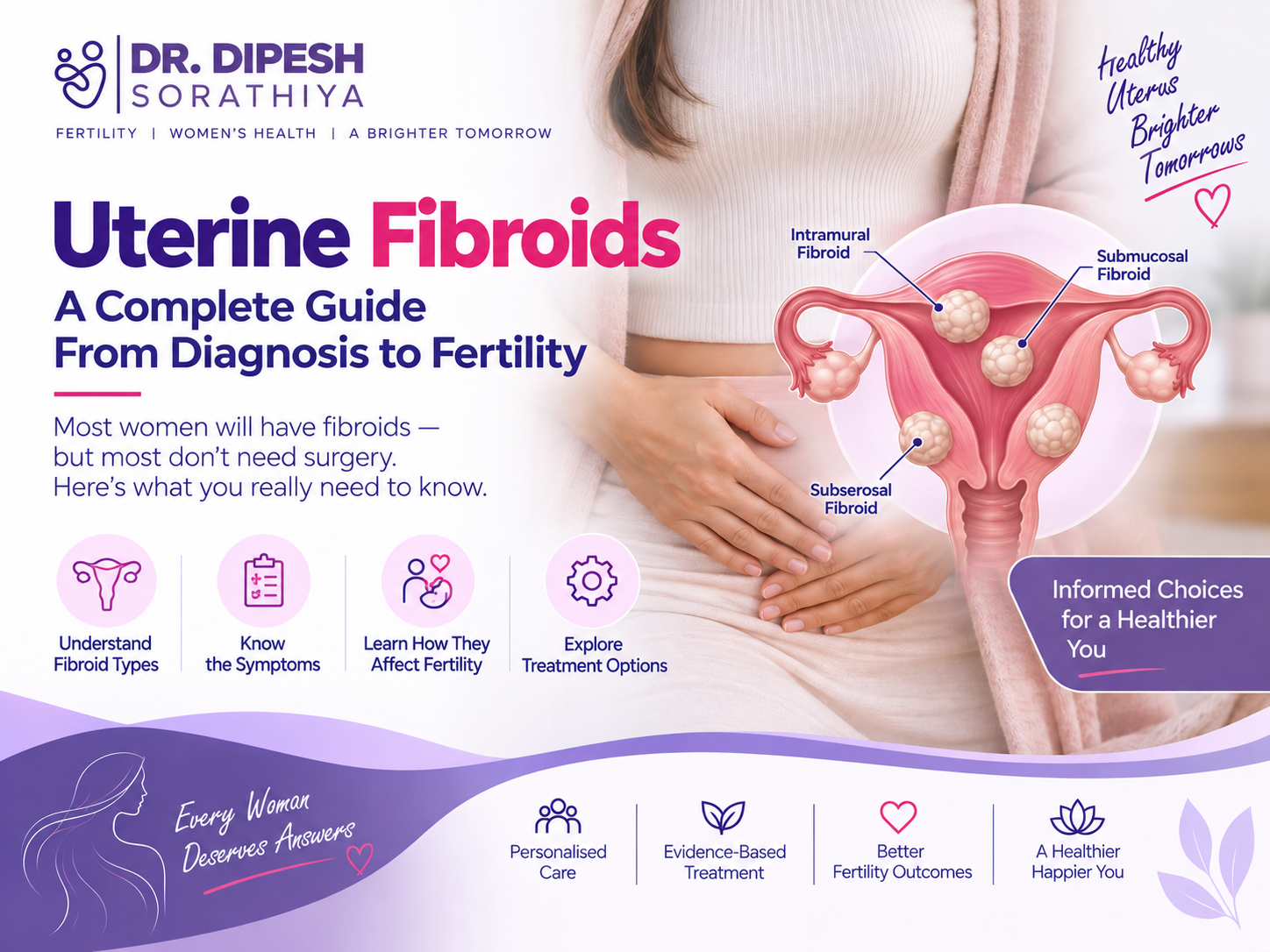
Uterine Fibroids — A Complete Guide From Diagnosis to Fertility
Fibroids are often found incidentally during a routine sonography done for something entirely unrelated. And yet, when the word "fibroid" appears on a report, the reaction is often panic. Surgery. Cancer. Infertility. All of these fears arrive at once.
Types of Fibroids — Why Location Matters More Than Size
| Type | Where It Grows and What It Causes |
|---|---|
| Intramural | Within the uterine wall — the most common type. May cause heavy periods and pelvic pressure if large. |
| Submucosal | Projects into the inner cavity of the uterus. Even small submucosal fibroids can significantly affect fertility and cause heavy bleeding, because they directly distort the cavity where embryo implantation occurs. |
| Subserosal | Projects outward from the outer surface. Causes pressure symptoms (frequent urination, constipation, pelvic heaviness) but generally has less impact on fertility. |
| Pedunculated | Hangs from a stalk — either inside the cavity or outside the uterus. |
Symptoms — When Fibroids Are a Problem
Many fibroids cause no symptoms at all. When they do cause problems:
- Heavy menstrual bleeding — soaking through pads quickly, large clots, periods lasting over 7 days
- Pelvic pressure, heaviness, or discomfort
- Frequent urination from bladder compression
- Constipation from rectal compression
- Back or leg pain from nerve compression (large fibroids)
- A visibly enlarged abdomen
- Iron deficiency anaemia from heavy blood loss
Fibroids and Fertility — Who Is Affected?
The critical question for women trying to conceive is: does my fibroid actually affect my ability to get pregnant? The answer depends almost entirely on type and location:
- Submucosal fibroids: Even small ones that distort the uterine cavity reduce implantation rates and increase miscarriage risk. These should be removed before attempting pregnancy — hysteroscopically, without opening the abdomen.
- Large intramural fibroids (typically over 4–5 cm): May distort the cavity or block the tubes — assessment and possible treatment needed.
- Subserosal fibroids: Evidence suggests they do not significantly impair fertility in most cases.
- Multiple fibroids: The cumulative effect depends on total size, location, and cavity involvement.
Many women carry fibroids through completely healthy pregnancies. The diagnosis alone does not equal a fertility problem.
A Fibroid on Your Report Isn't a Verdict
Whether a fibroid needs treatment depends on its type, location, and your goals — not on its presence alone. Consult Dr. Dipesh Sorathiya at Khushhi IVF, Thaltej, Ahmedabad for a clear assessment and the right plan for you.
Book an Appointment Learn About the ClinicTreatment Approaches
Watch and Wait
For small fibroids causing no symptoms, particularly in women approaching menopause (when fibroids naturally shrink), observation is entirely appropriate. A 6-monthly ultrasound to monitor size is all that's needed.
Medications
- GnRH agonists temporarily shrink fibroids by suppressing oestrogen — useful before surgery to reduce blood loss or fibroid size
- Tranexamic acid and NSAIDs reduce heavy bleeding without affecting fibroid growth
- Ulipristal acetate and mifepristone — used in some protocols to shrink fibroids before surgery
Hysteroscopic Myomectomy
The procedure of choice for submucosal fibroids — no incision, no scar. A thin telescope is inserted through the cervix. Day-care procedure with rapid recovery. Fertility completely preserved and typically improved.
Laparoscopic Myomectomy
Keyhole surgery for intramural or subserosal fibroids of manageable size. The uterus is preserved. Recovery is faster than open surgery.
Open (Abdominal) Myomectomy
For large, multiple, or inaccessible fibroids where laparoscopy isn't feasible. Uterus preserved; fertility preserved.
Uterine Artery Embolisation (UAE)
A radiological procedure that cuts off blood supply to fibroids, causing them to shrink. Used in women who want to avoid surgery and have no immediate fertility goals — not recommended as a primary approach for women who want to conceive.
Hysterectomy
Removal of the entire uterus — only considered when family is complete, symptoms are severe, and all other options have been exhausted. This is the last resort.
Frequently Asked Questions
Can fibroids turn into cancer?
No. Uterine sarcoma (cancer) is a separate, rare condition. Fibroids do not transform into cancer.
If my fibroid is removed, will it come back?
Myomectomy removes existing fibroids but doesn't eliminate the tendency to grow them. New fibroids can develop. After menopause, the risk of new growth falls dramatically.
Should I have my fibroid removed before IVF?
Only if it is submucosal (distorting the cavity) or if it is large and intramural in a position that could affect implantation. Your IVF specialist and sonographer should assess this together.
Khushhi IVF 5th Floor, Soham Pristine, Off Sindhubhavan Road, Thaltej, Ahmedabad, Gujarat 380054, India.
