


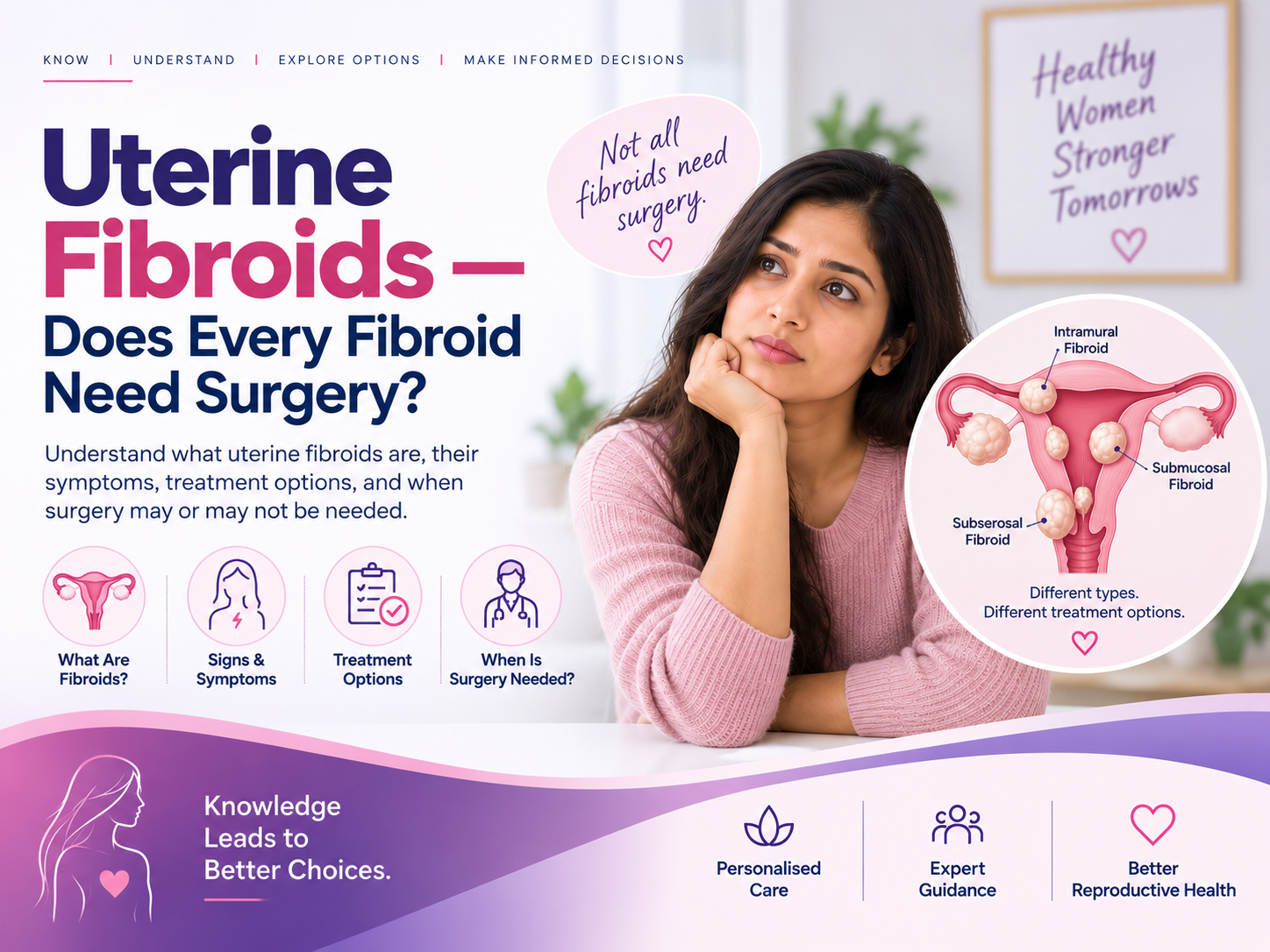
"Doctor, my sonography showed a fibroid (growth)" — and immediately the mind races. "Is it cancer?" "Will I need surgery?" "Can I still get pregnant?"
Many fibroids cause no symptoms whatsoever and are found incidentally during a routine sonography done for another reason.
Types of Fibroids — Location Matters
- Intramural: Within the wall of the uterus — the most common type
- Submucosal: Growing into the inner cavity of the uterus — most likely to cause heavy bleeding and affect fertility
- Subserosal: Growing outward from the outer surface of the uterus — tends to cause pressure symptoms
- Pedunculated: Hanging on a stalk from the uterus, either inward or outward
Symptoms — When Do Fibroids Cause Problems?
Many fibroids cause no symptoms at all. When they do, the most common complaints are:
- Heavy menstrual bleeding (menorrhagia): Very heavy flow, large clots, periods lasting 7+ days
- Pelvic pressure or fullness: A constant heaviness or pressure in the lower pelvis
- Frequent urination: A large fibroid pressing on the bladder
- Constipation: A fibroid pressing on the rectum
- Back or leg pain: From large fibroids pressing on nerves
- Bloated abdomen: A very large fibroid may make the abdomen visibly protrude
- Anaemia: Heavy bleeding depletes iron stores, causing profound fatigue
Causes — Why Do Fibroids Grow?
The exact cause isn't fully established, but we know:
- Fibroids are driven by oestrogen and progesterone — they grow during the reproductive years and typically shrink after menopause
- Genetics plays a significant role — if your mother or sister had fibroids, your risk is higher
- Early onset of periods
- Never having been pregnant or having a first pregnancy later in life
- Obesity, red meat consumption, and alcohol are associated with higher risk
- Vitamin D deficiency may play a role
How Do Fibroids Affect Fertility?
Most fibroids do not significantly affect fertility. However, location matters enormously:
- Submucosal fibroids (growing into the uterine cavity): These are the most fertility-relevant. They distort the cavity, block embryo implantation, and increase miscarriage risk. These should be treated before attempting pregnancy.
- Large intramural fibroids: Can distort the uterine shape or block the fallopian tubes.
- Subserosal fibroids: Generally have little impact on fertility.
Many women carry fibroids through healthy pregnancies. Fibroids don't automatically prevent conception.
Treatment — Surgery Is the Last Option, Not the First
Option 1: Watch and Wait
Small fibroids with no symptoms, particularly in women approaching menopause, often simply need monitoring. Fibroids naturally shrink after menopause as oestrogen falls.
Option 2: Medications
- GnRH agonists temporarily suppress oestrogen and shrink fibroids — used before surgery to reduce size
- Tranexamic acid and NSAIDs reduce heavy bleeding
- Hormonal IUD reduces bleeding without shrinking fibroids
Option 3: Hysteroscopic Myomectomy
For submucosal fibroids (inside the cavity) — no incision, no scar. A thin telescope is passed through the cervix and the fibroid is removed directly. Day-care procedure, quick recovery, uterus and fertility completely preserved.
Option 4: Laparoscopic Myomectomy
For smaller or medium-sized fibroids on or in the uterine wall. Keyhole surgery — fibroids removed through small incisions, uterus left intact. Faster recovery than open surgery. Fertility preserved.
Option 5: Open Myomectomy
For large or multiple fibroids — traditional open surgery. Fibroid is removed; uterus is preserved. Appropriate when laparoscopic approach isn't feasible.
Option 6: Hysterectomy (Removal of Uterus)
Only considered when: the family is complete, symptoms are severe and unresponsive to other treatments, and the woman and doctor agree this is the right decision. This is the last resort — not the first conversation.
Option 7: Uterine Artery Embolisation (UAE)
A radiological procedure that cuts off blood supply to fibroids, causing them to shrink. Used in selected cases at specialist centres.
A Fibroid Diagnosis Doesn't Mean Surgery Is Next
Most fibroids can be managed without surgery, and even when treatment is needed, uterus- and fertility-preserving options usually come first. Consult Dr. Dipesh Sorathiya at Khushhi IVF, Thaltej, Ahmedabad to understand which approach fits your situation.
Book an Appointment Learn About the ClinicFrequently Asked Questions
Is a fibroid the same as cancer?
No. Fibroids are benign. Uterine sarcoma (a rare uterine cancer) is an entirely separate condition and is extremely uncommon.
Can I get pregnant with a fibroid?
In many cases, yes. The decision to treat a fibroid before trying to conceive depends on its size, type, and location.
Can fibroids resolve without surgery?
Small, symptom-free fibroids may simply be monitored. After menopause, fibroids routinely shrink on their own. Surgery is for those causing symptoms or affecting fertility.
Do fibroids come back after removal?
New fibroids can form after myomectomy — the surgery removes existing ones but doesn't change the underlying tendency. After menopause, the risk of new growth falls significantly.
Khushhi IVF 5th Floor, Soham Pristine, Off Sindhubhavan Road, Thaltej, Ahmedabad, Gujarat 380054, India.
